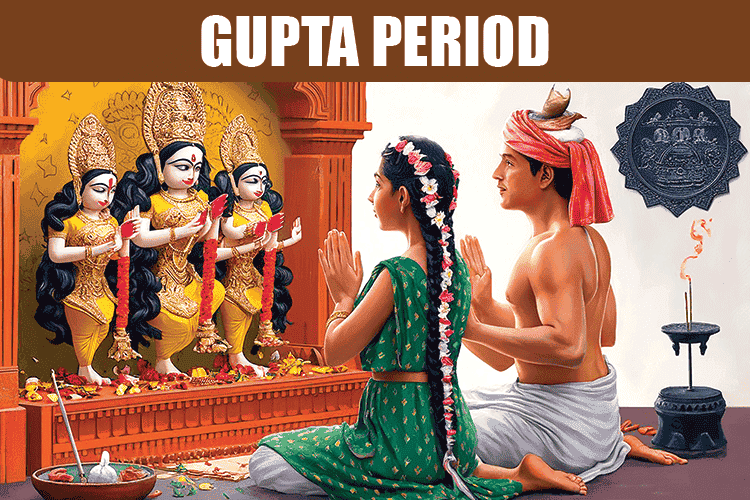
The Gupta era is called the Golden Age of India and its period is from 319 AD to 540 AD. It is marked by impressive achievements in art, literature, science, mathematics and astronomy. This chapter mainly contains many MCQ questions about the administration, society, economy and religion of the Gupta era. It is important for thorough study and understanding.
Who assumed the title of “Vikramaditya”?
Ans: Chandragupta II. [RRB Mumbai Supervisor, CDS, 2004]
During which Gupta king’s reign did the Chinese traveller Fahien visit India?
Ans: Chandragupta II. [SSC, CPO, SI, 2008]
Who organised “Ashwamedha Yajna”?
Ans: Samudragupta. [Bihar SSC, LDC, 2005]
Who was the first known Gupta ruler?
Ans: Srigupta. [SSC Grad, 2005]
During the reign of which dynasty did Kalidasa flourish?
Ans: Guptas. [SCRA, 2007]
The silver coins of the Gupta period were known as –
Ans: Rupyaka. [SSC Grad, 2006]
Which king of the Gupta Dynasty was called the “Napoleon of India”?
Ans: Samudragupta. [SSC Tax Assist, 2009]
Which period marks the beginning of Indian temple architecture?
Ans: Gupta. [SCRA, 2007]
“Kumarsambhavam”, an epic, was composed by –
Ans: Kalidasa. [45th BPSC, 2002]
In which century did the famous Chinese pilgrim Fahien visit India?
Ans: 5th century AD.
Aryabhatta and Varahmihira belong to which age?
Ans: Guptas. [CDS, 2006]
“Mrichhakatika” was written by –
Ans: Sudraka. [NDA, 2001]
In the courtyard of the Quwwat-ul-Islam Mosque of Delhi stands the famous iron pillar in the memory of –
Ans: Chandra. [UP PCS (P), 2002]
The six distinct schools of Indian philosophy – Sankhya, Yoga, Nyaya, Vaisheshika, Mimamsa, Vedanta – became fully articulated during the –
Ans: Vedic age. [CPO AC, 2003]
The decimal numeral system, including the concept of zero, was invented in India during which dynasty?
Ans: Gupta. [CDS, 2007]
Which was the official language of the Gupta Period?
Ans: Sanskrit. [NDA, 2009]
Which Gupta king granted permission to Meghavarma, the ruler of Sri Lanka, to build a Buddhist temple at Gaya?
Ans: Saudragupta. [CDS, 2003]
Sudraka’s “Mrichhakatikam” is a –
Ans: Drama. [WB PCS (P), 2004]
The first Gupta ruler to assume the title of “Parama Bhagavat” was –
Ans: Chandragupta II. [UP PCS (M), 2014]
Who was the founder of the Gupta dynasty?
Ans: Srigupta. [WB PCS (P), 2008]
There are only two known examples of cave paintings of the Gupta Period in ancient India. One of these is the paintings of Ajanta caves. Where is the other surviving example of Gupta paintings?
Ans: Bagh caves. [UPSC, 2010]
Who was the court poet of Samudragupta?
Ans: Harisen. [WB PCS, 2008]
Samudragupta has been given the title of “Indian Napoleon” by the Indians –
Ans: V.A. Smith. [WB PCS (P), 2008]
The Prayaga Prasasti/Allahabad pillar inscription is associated with –
Ans: Samudragupta. [UPSC, 2004]
During the Gupta period of Indian history, the village affairs were managed by the village headman with the assistance of –
Ans: Vishyapati. [C.D.S, 1994]
Which was an important port of the eastern coast during the Gupta Period?
Ans: Tamralipta.
The great Hindu law giver was –
Ans: Manu.
The Arab conquest of Sindh took place in –
Ans: 712 A.D. [C.D.S, 1993]
The original name of Kushanas was in –
Ans: Chinese Turkistan.
The Arab conquest of Sindh took place in 712 A.D. under the leadership of –
Ans: Muhammad bin Qasim. [C.D.S, 1991]
The Gupta feudatories who became strong and independent in Gujarat were known as –
Ans: Maitrakas. [C.D.S, 1995]
Which Gupta ruler had led a campaign to the south and was an expert “veena player”?
Ans: Samudragupta. [I. Tax & Central Excise, 1991]
The medium of exchange in gold during the Gupta period was known as the –
Ans: Suvarna.
The achievements of Samudragupta are described in the –
Ans: Allahabad Pillar inscription. [C.D.S, 1991]
Gupta dynasty was famous for –
Ans: Art and architecture.
Kanishka organised the fourth Buddhist council with a view to –
Ans: Examining the Buddhist scriptures and preparing commentaries.
Which Gupta ruler was equally great in the art of peace, wars and personal accomplishment?
Ans: Chandragupta II.
Who contributed most to the Bhagvata cult?
Ans: Guptas.
Who sent Hieun-Tsang as an envoy to Harsha’s court?
Ans: Tai Tsung. [UP PCS (P), 2007; BPSC, 2014]
Which inscription mentions Pulakesin’s military success against Harshavardhana?
Ans: Aihole Inscription. [C.D.S, 2010]
Harshavardhana was defeated by –
Ans: Pulakesin II. [SSC Grad, 2010]
The rock-cut temples of Mahabalipuram were built under the patronage of the –
Ans: Pallava kings. [CDS, 2000]
Two great religious conferences were held by king Harshavardhana at –
Ans: Kannauj and Prayag. [UP PCS (P), 2003]
In whose court was a Chinese embassy sent by the T’ang emperor?
Ans: Harshavardhana. [RRB Mumbai Supervisor/IESM, 2006]
Emperor Harsha’s southward march was stopped on the Narmada river by –
Ans: Pulakesin II. [UP PCS, 2001]
Who wrote the “Harshacharita”?
Ans: Banabhatta.
Where was the capital of Sasanka?
Ans: Karnasuvarna. [WB PCS (P), 2008]