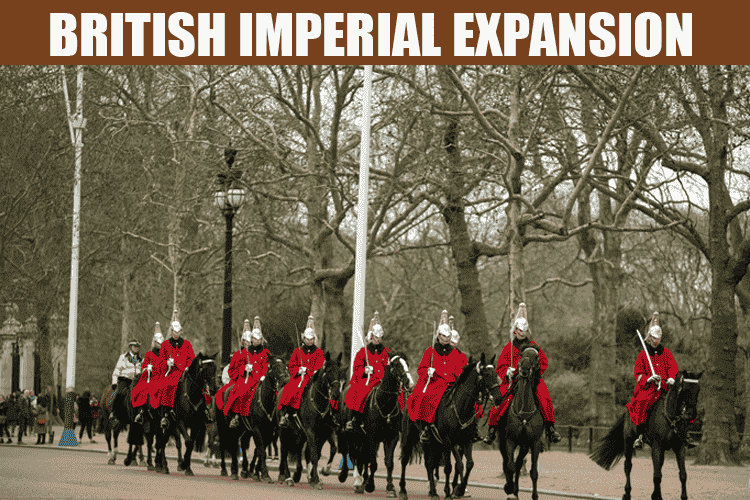
The history of modern India, covering the beginnings of the British Empire in India, the establishment of the East India Company's control over Bengal, Bihar and Orissa, and the impact of policies such as the Subsidiary Alliance and the Doctrine of Lapse.
British Imperial Expansion (In the Context of Bengal, Mysore, Punjab etc.)
1. When did the British Government start ruling India directly?
Ans:- After Sepoy Mutiny. [CPO SI, 2002]
2. Who issued Firman granting Diwani of Bengal, Bihar and Orissa to the English?
Ans:- Shah Alam II. [NDA, 2006]
3. Who was the first Governor General of Bengal?
Ans:- Warren Hastings. [CDS, 2006]
4. Emperor Shah Alam II gave the diwani of Bengal, Bihar and Orissa of East India company on –
Ans:- 12th August, 1765.
5. The first Governor General of India was appointed in –
Ans:- 1833. [Utt. PSC, 2007]
6. The first Governor General of India was
Ans:- Lord William Bentinck. [WBPSC, 2007]
7. The East India company secured the Diwani from –
Ans:- Shah Alam II. [WBPSC, 2008]
8. Which Acts did the Governor General of Bengal become the Governor General of India?
Ans:- The Charter Act of 1833. [CDS, 2006]
9. Khalsa was founded by –
Ans:- Guru Gobind Singh. [SSC Grad, 2005]
10. Which Sikh Guru helped the rebel prince Khusro with money and blessing?
Ans:- Guru Arjun Dev. [UP PCS (P), 2003]
11. In whose reign did Guru Nanak Deva establish Sikhism?
Ans:- Sikandar Lodi. [UP PSC (P), 2008]
12. Which was the capital of Raja Ranjit Singh of Punjab?
Ans:- Lahore. [Utt. PSC, 2005]
13. Who compiled “Adigranth” or “Guru Granth Saheb”?
Ans:- Guru Arjun Dev. [Utt. PSC, 2005]
14. Who converted Sikh into a martial race?
Ans:- Gobind Singh. [WBPSC, 2007]
15. Who founded Sikhism?
Ans:- Nanak. [WBPSC, 2007]
16. The Gurumukhi script was introduced by –
Ans:- Guru Angad. [WBPSC, 2008]
17. Which Sikh Guru assumed the title “Sachcha Padshah”?
Ans:- Guru Teg Bahadur. [WBPCS, 2007]
18. Who succeeded Guru Nanak?
Ans:- Guru Angad. [SSC CGL, 2014]
19. Which was the birth place of Guru Nanak?
Ans:- Talwandi. [SSC, 2006]
20. Tipu Sultan took support of which powers to fight the English?
Ans:- French. [SCRA, 2005]
21. Which place was famous as capital of Tipu Sultan?
Ans:- Srirangpattam. [RRB, 2008]
22. The State of Jhansi was made a part of the British Empire in India through –
Ans:- The Policy of Doctrine of Lapse.
23. Tipu Sultan died fighting the English forces under –
Ans:- Lord Wellesley. [CPF Assit. Commt, 2008]
24. The founder of the autonomous kingdom of Avadh was –
Ans:- Saadat Khan Burhan-ul-Mulk. [CDS, 2004]
25. The main cause of the conflict between Nawab Sirajuddaula and the East India Company was that –
Ans:- The British misused the Dustaq (Free duty passes). [C.D.S, 2004]
26. What was the ground for the British Empire to annex Sambalpur in 1850?
Ans:- Death of its ruler without an heir. [CDS, 2008]
27. Who was appointed Deputy Diwan of Murshidabad (Bengal) by Robert Clive after the Allahabad Treaty?
Ans:- Mohd. Reza Khan. [45th BPSC, 2002]
28. Which Indian was appointed as Deputy Diwan of Bihar by Robert Clive?
Ans:- Raja Shitab Rai. [44th BPSC, 2001]
29. The Successor of Maharaja Ranjit Singh was –
Ans:- Kharaq Singh. [JPSC, 2003]
30. A group of eunuchs and ladies dominated in the Government under:
Ans:- Ahmed Shah (1748–54). [UP PCS (M), 2004]
31. The book “Jiz Muhammad shahi” related to knowledge of Astrology produced in 1733 is written by –
Ans:- Sawai Jai Singh II of Jaipur.
32. Which Indian ruler established embassies in foreign countries on modern lines?
Ans:- Tipu Sultan. [UPSC, 2001]
33. How did the Mughal Emperor Jahandar Shah’s reign come to an early end?
Ans:- He was defeated by his nephew in a battle. [UPSC, 2003]
34. The ruler of which one of the states was removed from power by the British on the pretext of misgovernance?
Ans:- Awadh. [UPSC, 2007]
35. Which Governor General had entertained Ranjit Singh with great honour at Ropar?
Ans:- William Bentinck. [SSC, 2007]
36. In which years, the battle of Buxar was fought?
Ans:- 1764. [RRB, 2006]
37. Who was the first Indian native ruler to accept the system of Subsidiary Alliance?
Ans:- Nizam of Hyderabad. [NDA, 2007; CDS, 2003]
38. Who joined Mir Qasim and Sirajuddaula in declaring war upon the English East India Company and was later defeated by the British at the Battle of Buxar?
Ans:- Shah Alam II. [CDS, 2004, 2006]
39. Which Governor General is associated with Doctrine of Lapse?
Ans:- Lord Dalhousie. [SSC Grad, 2010]
40. Who annexed Punjab into the British dominion?
Ans:- Lord Dalhousie.
41. Treaty of Allahabad was signed between whom?
Ans:- On 16th August, 1765 the Treaty of Allahabad was signed between Mughal Emperor Shah Alam II and Robert Clive of the British East India Company.
42. The treaty of Purandar was signed between –
Ans:- On 11th June, 1665 the Treaty of Purandar was signed between Maratha Chhatrapati Shivaji and Raja Jai Singh, who was leading the Mughal forces on behalf of Aurangzeb.
43. Who Signed the Treaty of Mangalore?
Ans:- On 11th March, 1784 the Treaty of Mangalore was signed between Tipu Sultan and the British East India Company. It marked the end of the second Anglo–Mysore War.
44. The Treaty of Seringapatam was signed between –
Ans:- On March 18th, 1792 the Treaty of Seringapatam was signed between Tipu Sultan and the British East India Company led by Lord Cornwallis.
45. Treaty of Yandabo was signed between –
Ans:- On February 24th, 1826 the Treaty of Yandabo was signed between the British East India Company and the kingdom of Burma. This treaty ended the First Anglo-Burmese War.
46. Treaty of Salbai was Signed between –
Ans:- On 17th May, 1782 the Treaty of Salbai was signed between Maratha Empire and the British East India Company.
47. Treaty of Lahore was signed between –
Ans:- On 9th March, 1846 the Treaty of Lahore was signed between Sikhs and the British.
48. When was the Treaty of Amritsar Signed?
Ans:- On 25th April, 1809 the Treaty of Amritsar was signed between Maharaja Ranjit Singh of the Sikh Empire and the British East India Company led by Charles T. Metcalfe.
49. To whom the Treaty of Amritsar in 1846 was Signed?
Ans:- In 1846 the Treaty of Amritsar was signed between the British East India Company and Raja Gulab Singh of Jammu. This treaty sanctioned the transfer of Kashmir from the British to Gulab Singh in terms of monetary exchange for 75 lakh rupees. As a result, the princely state of Jammu and Kashmir was established under Dogra rule.
50. When was the Treaty of Mangalore Signed?
Ans:- On 11th March, 1784 the Treaty of Mangalore was signed between Tipu Sultan and the British East India Company.
51. When was the Treaty of Versailles Signed?
Ans:- On 28th June, 1919 the Treaty of Versailles was Signed between Germany and the Allied powers. It formally ends the World War I.
52. Hyder Ali was defeated at Porto Novo by Which British General?
Ans:- Sir Eyre Coote. [JPSC, 2003]
53. Sirajuddaulah was defeated by Lord Clive in the battle of –
Ans:- Plassey (1757). [UP PSC, 2003]
54. First decisive military success of English East India Company in India is marked by –
Ans:- Battle of Buxar (22nd October, 1764).
55. Who founded independent Sultanate of Bengal?
Ans:- Murshid Quli Khan. [WBPSC, 2007]
56. Who was not involved in the conspiracy against Sirajuddaulah?
Ans:- Mohanlal. [WBPSC, 2008]
57. Who was the Governor General when the first Anglo-Burmese war started?
Ans:- Lord Amherst. [WBPSC, 2008]
58. When the First Anglo–Maratha war was started?
Ans:- In 1775-1782, First Anglo-Maratha War was started between the British East India Company and the Maratha Confederacy in India. Marathas won the first battle.
59. When the second Anglo–Maratha War was started?
Ans:- In 1803-1805, the Second Anglo-Maratha war was started between the Maratha and the British East India Company. Maratha lost against the British in this war.
60. When the third Anglo-Maratha War was started?
Ans:- In 1817-1819, Third Anglo-Maratha war was the started between Maratha and British East India Company. British won the third battle.
61. Who was the last independent Nawab of Bengal?
Ans:- Mir Kasim. [WBPSC, 2008]
62. List of wars and their period are written below –
Ans:-
|
War |
Period |
|
First Anglo-Maratha War (Maratha vs British East India Company) |
1775-1782 |
|
Second Anglo-Maratha War (Maratha vs British East India Company) |
1803-1805 |
|
Third Anglo-Maratha War (Maratha vs British East India Company) |
1817-1819 |
|
First Anglo-Mysore War (Hyder Ali vs British East India Company) |
1767-1769 |
|
Second Anglo-Mysore War (Hyder Ali with support of Nizam and Marathas vs British East India Company) |
1780-1784 |
|
Third Anglo-Mysore War (Tipu Sultan vs British East India Company) |
1790-1792 |
|
Fourth Anglo-Mysore War (Tipu Sultan vs British East India Company) |
1799 |
|
First Anglo-Sikh War (Sikh Empire vs British East India Company) |
1845-1846 |
|
Second Anglo-Sikh War |
1848-1849 |
|
First Anglo-Afghan War |
1839-1842 |
|
Second Anglo-Afghan War |
1878-1880 |
|
Third Anglo-Afghan War |
1919 |
63. The last major extension of British Indian territory took place during the time of –
Ans:- Dufferin. [UPSC, 2000]
64. Who betrayed Siraj-Ud-Daula in the battle of Plassey in 1757?
Ans:- Mir Jafar. [SSC, CGL, 2014]
65. Who was the Nawab of Bengal during battle of Plassey?
Ans:- Siraj-Ud-Daula. [SSC, CGL, 2014]
66. The title ‘Punjab Kesari’ was conferred on –
Ans:- Lala Lajpat Rai. [CDS, 1991]
67. The affairs of East India Company came into the hands of the British Crown under –
Ans:- Government of India Act.
68. Which are the three landmarks of Dalhousie’s administration?
Ans:-
i) Indian Railways
ii) Public Works Department
iii) Telegraph. [I.E.S, 1991]
69. Abandonment of the policy of annexation and aggrandizement towards Indian States came under the –
Ans:- Government of India Act, 1858. [C.B.I, 1994]
70. The British Governor General, who formulated the policy of Subsidiary Alliance with regard to Indian powers was –
Ans:- Lord Wellesley. [Railways, 1994]
71. The first main British Parliamentary Act regarding East India Company’s administration in India was –
Ans:- Regulating Act.
72. Permanent Revenue System of Lord Cornwallis proved oppressive to the tenants because they were –
Ans:- exploited by the Zamindars. [C.B.I, 1993]
73. The Doctrine of Lapse was introduced by –
Ans:- Lord Dalhousie. [U.D.C, 1993; C.B.I, 1990]
74. The Act which imparted provincial autonomy is –
Ans:- Government of India Act, 1935. [I.E.S, 1991]
75. The office of the Secretary of State for India was created by the –
Ans:- Government of India Act, 1858.
76. The title of Governor-General was changed to that of Viceroy in the year –
Ans:- 1858 A.D.
77. Which Governor General abolished the system of dual government established by Robert Clive and established the Company’s control over Bengal?
Ans:- Warren Hastings.
78. The first Indian Councils Act was passed in –
Ans:- 1861.
79. When was the monopoly of East India Company in trade brought under the control of the British Crown?
Ans:- 1773 A.D.
80. When the East India Company came into existence, England was ruled by the –
Ans:- Stuarts. [CDS, 1991]
81. Which Act was the first legislative interference by the British Parliament in the affairs of India?
Ans:- The Regulating Act, 1773.
82. The first Governor General of India was appointed in –
Ans:- 1833.
83. (Repeat) The first Governor General of India was
Ans:- Lord William Bentinck. [WBPSC, 2007