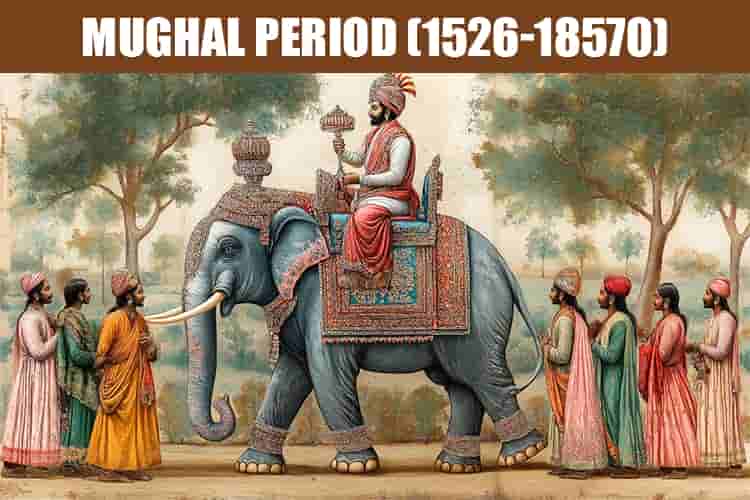
The Mughal Empire, which ruled India for over three centuries, was established after the First Battle of Panipat. From the Mansabdari, the Jabati revenue system, Sulah-i-Kul and Din-i-Ilahi to great monuments like the Taj Mahal and the Red Fort, the empire collapsed in 1857 due to invasions, internal conflicts and rising regional powers.
Mughal Period (1526-18570)
1. The Mansabdari system introduced by Akbar was borrowed from the system in –
Ans:- Mongolia. [I.A.S, 1994]
2. The capital of the Mughal Empire was shifted from Agra to Delhi by –
Ans:- Shahjahan.
3. In 1662 A.D, Mirjumla, the Mughal viceroy of Bengal led a successful expedition to –
Ans:- Assam. [C.D.S,1991]
4. Which port was the biggest during the Mughal Period?
Ans:- Surat. [Central Excise, 1991]
5. When Akbar was young, his guardian was –
Ans:- Bairam Khan. [N.D.A,1994]
6. The two great Mughal rulers who wrote their own memories are –
Ans:- Babar and Jahangir.
7. During the Mughal period, under the zabti system, land revenue was assessed and was required to be paid –
Ans:- in cash or kind. [I.A.S, 1990]
8. Revenue system during Akbar’s reign was in the hands of –
Ans:- Todar Mal.
9. During the reign of which emperor was the artillery most perfect and numerous?
Ans:- Aurangzeb.
10. The court language of Mughals was –
Ans:- Persian.
11. Akbar founded the Din-i-Ilahi primarily to –
Ans:- Establish a national religion which would be acceptable to the Muslims and the Hindus.
12. During Sher Shah’s reign, the document containing the information of the tax that the farmer had to pay was called –
Ans:- Patta.
13. Akbar assumed actual control over the administration of his empire in –
Ans:- 1556. [C.D.S, 1991]
14. Which Mughal ruler introduced Rajput patrons in the administration of his empire?
Ans:- Akbar.
15. Who consolidated the Mughal empire and gave it a unique multi-religious culture?
Ans:- Akbar. [U.D.C, 1994]
16. Who was the first Mughal emperor to allow the British to establish trade links with India?
Ans:- Jahangir.
17. Who was the last Mughal emperor to sit on the Peacock Throne?
Ans:- Muhammad Shah.
18. During the Mughal period, the in-charge of law and order in the village was –
Ans:- Muqaddam.
19. The “Jaziya” was abolished by –
Ans:- Akbar.
20. Din-i-Ilahi was accepted by –
Ans:- Birbal.
21. The dee-aspah sih-aspah system was introduced by –
Ans:- Akbar. [Teacher’s Exam, 1990]
22. Akbar’s land revenue system was known as –
Ans:- zabti system. [C.B.I, 1991]
23. The East India company was founded in India during the reign of –
Ans:- Akbar. [Railways, 1991]
24. The Mughal ruler Bahadur Shah II was exiled by the British and sent to –
Ans:- Rangoon.
25. The first Mughal emperor to issue a farman in favour of the British to open a factory at Surat was –
Ans:- Jahangir.
26. Which contemporary source of the Mughal period is especially useful for obtaining information on the agrarian condition?
Ans:- Ain-i-Akbari.
27. The Mughal emperor who died due to a sudden fall from the staircase was –
Ans:- Humayun.
28. Which Mughal emperor gave land for the construction of the Golden Temple at Amritsar?
Ans:- Akbar. [Central Excise,1989]
29. Babar entered India for the first time from west through –
Ans:- Punjab. [Railways, 1991]
30. Which Mughal ruler had the “Chains of Justice” fastened up which could be shaken by his subjects to bring their grievances to his notice?
Ans:- Jahangir.
31. In the Mughal administration, military recruitment was looked after by –
Ans:- Bakhshi. [C.D.S, 1992]
32. Who was regarded as “Zinda Pir”?
Ans:- Aurangzeb.
33. Chand Bibi who ceded Berar to Akbar was the ruler of –
Ans:- Ahmednagar. [Assistant Grade, 1991]
34. The bone of contention between the Shah of Persia and the Mughals was the control of –
Ans:- Kandhar. [Teacher’s Exam, 1994]
35. Akbar has been called the “First national king” mainly because he –
Ans:- Was highly tolerant and secular in his outlook. [Assistant Grade, 1993]
36. The designation “Amil” in Akbar’s time meant –
Ans:- revenue officer.
37. Aurangzeb attacked Bijapur and Golconda because –
Ans:- of Aurangzeb’s policy of expansion and to consolidate his supremacy. [Railways, 1992]
38. Which Rajput dynasties did not surrender to Akbar?
Ans:- Pratihara. [N.D.A, 1993]
39. Which emperors annexed Bijapur and Golconda to the Mughal empire?
Ans:- Aurangzeb. [I.F.S, 1993]
40. Sher Shah made revenue settlement with –
Ans:- Cultivators.
41. Tulsi Das was a contemporary of –
Ans:- Akbar.
42. The king generally considered to be the greatest ruler of Kashmir in the 15th century was –
Ans:- Zain-ul-Abidin.
43. Delhi became the established capital of Mughal kings during the reign of –
Ans:- Akbar.
44. The main object of introducing the Mansabdari system was to –
Ans:- Organise the Army. [C.D.S, 1993]
45. Akbar collected a very valuable library of manuscripts on all subjects because –
Ans:- He wanted to start a new religion. [Transmission Executives’ Exam, 1994]
46. Lane Poole, the historian writes “the Emperor tumbled through life, and he tumbled out of it.” This statement refers to –
Ans:- Humayun.
47. Banda Singh Bahadur was executed by the orders of which emperor?
Ans:- Farrukh Siyar.
48. In reforming land revenue system, Sher Shah Suri took which steps?
Ans:-
a) He did away with the authority of the middle men and established direct relation with the tenants.
b) He abolished Jagirs and zamindari system.
c) He fixed the government’s share of the produce at less than one third of the produce.
49. During the decline of the Mughal empire the Jats were organized into a political force by –
Ans:- Badan Singh.
50. Sher Shah’s real name was –
Ans:- Farid.
51. Who was defeated by Babur in the first Battle of Panipat?
Ans:- Ibrahim Lodi. [SCRA, 2003]
52. Which important event took place in the history of India in the year 1526?
Ans:- The first battle of Panipat. [RRB Mumbai Supervisor/ IESM, 2006]
53. Between whom was the battle of Chausa fought?
Ans:- Humayun and Sher Khan. [NDA, 2007]
54. The battle of Khanwa in 1527 was fought between –
Ans:- Babur and Rana Sanga. [CDS, 2000, 2006, NDA, 2008]
55. Who among the following has issued the coin rupee for the first time?
Ans:- Sher Shah Suri. [CDS, 2009]
56. When did Humayun first attack Chunar fort?
Ans:- 1532 A.D.
57. Which one of the rulers first assumed the title of “Hazrat-i-Ala” and afterwards “Sultan”?
Ans:- Sher Shah Suri. [44th BPSC, 2001]
58. Who is believed to have created the raga “Miyan Ki Malhar”?
Ans:- Tansen. [SSC Grad, 2004]
59. A renowned Jain Scholar who was greatly honoured by Akbar was –
Ans:- Harivijaya. [SSC Mat, 2008]
60. The original name of Tansen, the most famous musician at the court of Akbar was –
Ans:- Ramtanu Pande . [SSC Grad, 2008, CDS, 2009]
61. Who is the author of “Ain-i-Akbari”?
Ans:- Abul Fazl. [SSC Tax Assist, 2009]
62. Tulsidas composed his “Ramcharitmansa” in the reign of –
Ans:- Akbar. [CDS, 2001]
63. Who did illustrate “Dastan-i-Amir Hamza”?
Ans:- Abdus Samad.
64. The world famous “Thakht-i-Taus” (the Peacock Throne) was kept in which Mughal building?
Ans:- The Diwan-i-Am at the Red Fort at Delhi. [SSC Sec. off (Aud), 2006]
65. Where did Babur die?
Ans:- Agra. [SSC Tax Assist, 2009]
66. “Din-e-Ilahi” of Akbar was not a success because –
Ans:-
a) After Akbar it was not patronised.
b) The Muslims did not accept other religious practices.
c) It was not suitably projected to the masses. [SSC Tax Assist, 2009]
67. The famous Kohinoor diamond was produced from one of the mines in –
Ans:- Golconda. [SSC Sec. off (Aud), 2006]
68. Who was an illiterate Mughal emperor?
Ans:- Akbar.
69. Mughal painting flourished during the reign of –
Ans:- Jahangir. [RRB Mumbai Supervisor/ IESM, 2006]
70. Which Mughal painter according to Abul Fazl was excellent in drawing of features?
Ans:- Basawan. [UGC NET/ JRF (History), 2007]
71. Mughal presence in the Red Fort ceased with the fall of –
Ans:- Bahadur Shah Zafar. [SSC Grad, 2005]
72. The first Indian Hindi scholar of the Mughal period was –
Ans:- Abdur Rahim. [SSC Sec. off, 2010]
73. Various events and their year of occurrence are written below –
Ans:-
|
Event |
Year |
|
Conquest of Malwa |
1561 |
|
Closure of the Ibadat Khana |
1582 |
|
Introduction of Illahi era |
1584 |
|
Conquest of Orissa |
1592 |
74. Dara Shikoh finally lost the war of succession to Aurangzeb in the battle of –
Ans:- Samugarh. [CPF Assit. Commat, 2008]
75. During the reign of Akbar, the role of an official called Amalguzar was –
Ans:- To make an assessment and collection of land revenue. [NDA, 2002]
76. Name of writers and their works are written below –
Ans:-
|
Name |
Work |
|
Abdul Hamid Lahori |
“Badshahnama” |
|
Abul Fazal |
“Akbarnama” and “Ain-i-Akbari” |
|
Badauni |
“Muntakhab-ut-Tawarikh” |
|
Nizamuddin Ahmed |
“Tabaqat-i-Akbari” |
|
Jahangir |
“Tuzuk-i-Jahangiri” |
77. The Moti Masjid in Agra was built during the reign of –
Ans:- Shahjahan. [NDA, 2002, CPO SI, 2003]
78. In the reign of Jahangir, Kandhar could not be recaptured due to –
Ans:-
a) Refusal of Khurram to proceed to that place.
b) Difficulties in organising an expedition.
c) Severe cold in Afghanistan. [CDS, 2000]
79. Which territory was outside the boundaries of the Mughal empire during the reign of Akbar?
Ans:- Bijapur. [NDA, 2004]
80. At the time when Nadir shah attacked Delhi, the Mughal emperor was –
Ans:- Muhammad Shah. [CDS, 2001]
81. Which structure was constructed by Emperor Akbar in Fatehpur Sikri?
Ans:- Panch Mahal. [CDS, 2003]
82. The Mughal empire extended up to Tamil territory in the south under the reign of –
Ans:- Aurangzeb. [CDS, 2004]
83. Who built the Ibadatkhana at Fatehpur Sikri?
Ans:- Akbar. [CDS, 2008]
84. In the Mughal administration “Madad-i-Mash” indicates –
Ans:- Revenue free land given to learned persons. [46th BPSC, 2004]
85. Which Mughal emperor annexed Gujarat?
Ans:- Akbar. [CDS, 2005]
86. Who did illustrate “Dastan-i-Amir Hamza”?
Ans:- Abdus Samad. [46th BPSC, 2004]
87. Akbar merged Bengal and Bihar into his empire in –
Ans:- 1576 A.D.
88. During Mughal Empire, which of the provinces was lost in 1622, recovered in 1638 and finally lost in 1649?
Ans:- Kandahar. [CDS, 2002]
89. In the Mughal administration “Muhatsib” was –
Ans:- an officer-in-charge of public morals. [47th BPSC, 2005]
90. Who is the author of the book “The Last Mughal: The Fall of a Dynasty, Delhi,1857”?
Ans:- William Dalrymple. [CDS, 2007]
91. Which Mughal emperor spent a greater part of his reign trying to overthrow the Deccan kingdom?
Ans:- Aurangzeb. [NDA, 2006]
92. What were the “Ahdis” of Akbar’s time?
Ans:- Foot soldiers in the Army. [CDS, 2008]
93. The Mughal Emperor who appointed the maximum number of Hindu officers was –
Ans:- Aurangzeb.
94. Who deserves the credit for constructing Lal Qila?
Ans:- Shahjahan. [UP PCS (P), 2002]
95. Itimad-ud-Daula’s tomb at Agra was built by –
Ans:- Noorjahan. [BPSC, 2008]
96. The “Upanishads” were translated into Persian by Dara Shikoh under the title –
Ans:- Sirr-i-Akbar. [SSC, 2010]
97. The first English person who visited the court of Akbar was –
Ans:- Ralph Fitch. [JPSC, 2003]
98. Two states which Aurangzeb had conquered in Deccan, were –
Ans:- Bijapur and Golconda. [UP PCS (P), 2004]
99. The original name of Mumtaz Mahal was –
Ans:- Arjumand Bano Begum. [JPSC, 2003]
100. The first matrimonial alliance with the Rajputs was established by Akbar with the house of –
Ans:- Kachhawahas. [UP PCS, 2002]
101. Which building built by Akbar was designed on the principles of Buddhist Vihara?
Ans:- Panch Mahal. [JPSC, 2003]
102. Where is the mausoleum of Sher Shah?
Ans:- Sasaram. [UP PCS, 2002]
103. Which Mughal Emperor introduced the policy of Sulah-i-Kul?
Ans:- Akbar. [JPSC, 2003; CDS, 2008]
104. Jaziya was reimposed during the reign of –
Ans:- Aurangzeb. [UP PCS, 2002]
105. Who built the tomb of her emperor husband?
Ans:- Haji Begum. [UP PCS, 2004]
106. The Mughal Emperor who prohibited the use of tobacco was –
Ans:- Aurangzeb. [UP PCS, 2005]
107. The historian Abul Fazl was killed by –
Ans:- Bir Singhdeo Bundela. [MP PSC, 2009]
108. Who was the daughter of Emperor Aurangzeb?
Ans:- Zebunnisa. [UP PCS, 2005]
109. The ruler of Mewar who was defeated in the battle of Khanwa by Babur in 1527 was –
Ans:- Rana Sanga. [UP PCS, 2004]
110. During the Mughal rule, the copper coin was known as –
Ans:- dam. [UP PCS, 2008]
111. Mughal Emperor Jahangir gave the title “English khan” to –
Ans:- William Hawkins. [UP PCS (P), 2015]
112. The Battle of Dharmat was fought between –
Ans:- Aurangzeb and Dara Shikoh. [UPSC, 2003]
113. Akbar held his religious discussion in –
Ans:- Ibadat Khana. [SSC CGL, 2014]
114. Emperors and their tombs are written below –
Ans:-
|
Emperor |
Tomb |
|
Babur |
Kabul, Afghanistan |
|
Akbar |
Sikandara |
|
Jahangir |
Lahore |
|
Shahjahan |
Agra |
|
Humayun |
Nizamuddin East, Delhi |
|
Aurangzeb |
Khuldabad, Aurangabad district, Maharashtra |
115. What was district known as during the Mughal administration?
Ans:- Sarkar. [Utt. PSC, 2005]
116. Which Indian ruler was a contemporary of Akbar?
Ans:- Rani Durgavati. [CPO AC, 2003]
117. Who was conferred the title of “Gun raj Khan”?
Ans:- Maladhar Basu. [WBPSC, 2004]
118. Which part was called “Babul Makka” (Gate of Makka) during the Mughal period?
Ans:- Surat. [UPSC, 2001]
119. “Kabuliyat” and “Patta” were introduced by –
Ans:- Sher Shah. [WB PSC, 2007, 2008]
120. In Indian history, who was Abdul Hamid Lahori?
Ans:- an official historian of the reign of Shahjahan. [UPSC, 2006]
121. The famous diamond “Kohinoor” was presented to Shahjahan by –
Ans:- Mir Jumla. [UP PCS (M), 2015]
122. Who wrote “Humayun Nama”?
Ans:- Gulbadan Begum. [WB PSC, 2008]
123. In 1540, Sher Shah defeated Humayun at –
Ans:- Kannauj. [WB PSC, 2008]
124. Sher Shah was buried at –
Ans:- Sasaram. [UP PCS (M), 2015]
125. Aurangzeb defeated Jaswant Singh, the ruler of Jodhpur in the war of Dharmat of 1658. In which state is Dharmat situated?
Ans:- Madhya Pradesh. [RAS/ RTS, 2007]
126. Babur assumed the title of “Badshah” first at –
Ans:- Kabul. [UP PCS (M), 2015]
127. Which historical monument in Delhi is a synthesis of Persian and Indian styles of architecture?
Ans:- Humayun’s Tomb. [RAS/ RTS, 2003]
128. Alam Khan, who invited Babur to invade India was –
Ans:- an uncle of Ibrahim Lodi who was ill treated and expelled from the country. [UPSC, 2003]