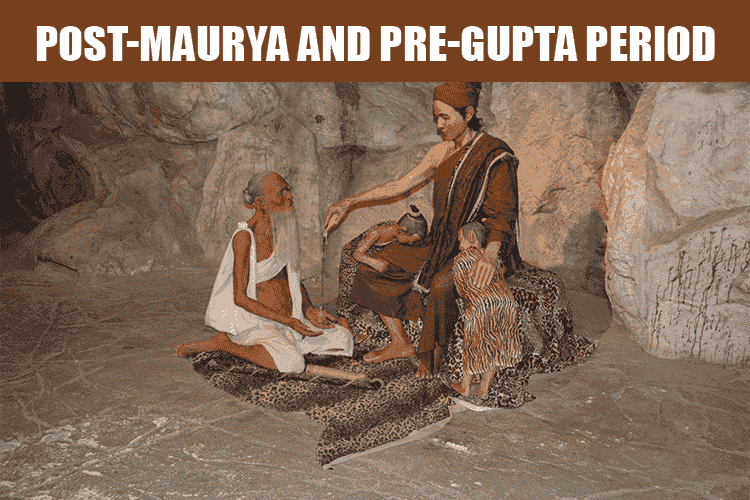
The medieval period between the end of the Mauryan Empire and the beginning of the Gupta period marks a turning point in Indian history. During this period, the Mauryan Empire fell and regional kingdoms such as the Sungas, Kanvas, Satavahanas, Indo-Greeks, Shakas, and Kushanas rose.
1. With whose reign is the Gandhara school of Art associated?
Ans: Kanishka. [RRB Mumbai Supervisor]
2. Who were the first kings to issue gold coins in India?
Ans: Indo-Greeks. [SSC Grad. 2001, WB PSC (P) 2007]
3. Who presided over the Buddhist council held during the reign of Kanishka at Kashmir?
Ans: Vasumitra. [UPSC, 2001]
4. A Buddhist council during the reign of Kanishka was held at –
Ans: Kashmir. [47th BPSC, 2005]
5. In which year was Sakabda / Saka Samvatsar started?
Ans: 78 AD.
6. Yavanika (Curtain) was introduced in Indian theatre by which dynasties?
Ans: Greeks.
7. Who among the following were contemporaries of Kanishka?
Ans: Nagarjuna, Ashvaghosha, Vasumitra. [SSC Gr. 2003, RRB, 2006]
8. What was the capital of Kanishka?
Ans: Purushapura or Peshawar. [SSC Gr. 2006]
9. At which of the following places was the headless statue of Kanishka found?
Ans: Mathura. [SCRA, 2001]
10. Which dynasties were associated with Gandhara School of Art?
Ans: Kushans. [NDA, 2006]
11. Which Chinese general defeated Kanishka?
Ans: Pen Chao. [JPSC, 2003]
12. The art style which combines Indian and Greek features is called –
Ans: Gandhara. [RAS/ RTS, 2008]
13. When did the Mathura school of Art flourish?
Ans: Kushana Period. [WB PSC (P), 2008]
14. Chaitra-1 of the national calendar based on the Saka era corresponds to which dates of the Gregorian calendar?
Ans: 22nd March (or 21st March). [UPSC, 2014]
15. The greatest development in the Kushana period was in the field of –
Ans: Art. [SSC Gr. 2005]
16. St. Thomas is said to have come to India to propagate Christianity during the reign of –
Ans: Gondapharnese (Parthian). [SSC Sec. off (Aud), 2008]
17. Charak was the famous court physician of –
Ans: Kanishka. [SSC Data Entry Operator, 2009]
18. In the kingdom of Satavahanas of ancient India, a district was called –
Ans: Ahara. [SCRA, 2001]
19. Who started the Saka Era and when?
Ans: Kanishka in 78 AD. [SSC Tax Assist, 2008; WB PCS (P), 2008]
20. The destruction of the Mauryan Empire was followed by a series of invasions, and the first to invade India were the –
Ans: Indo-Bactrians. [CDS, 2004]
21. Which dynasties succeeded Sungas?
Ans: Kanvas. [45th BPSC, 2002]
22. The Capital of Satavahanas was located at –
Ans: Paithan. [UP PCS (M), 2005]
23. Which ruler has been mentioned as protector of the Varna system?
Ans: Kharavela. [MP PSC, 2009]
24. Who was called the Vindhya Adhipati?
Ans: Gautamiputra Satakarni.
25. The practice of military governorship was first introduced in India by the –
Ans: Greeks. [UPSC, 2000]
26. Who renovated Sudarshan Lake without using forced labour?
Ans: Rudradaman. [UP PCS (M), 2014]
27. Who introduced gold coins for regular use in India?
Ans: Vima Kadphises. [UP PCS, 2014]
28. Sakas were finally overthrown by –
Ans: Gautamiputra Satakarni. [Railways, 1995]
29. Which state was a republic in sixth century B.C?
Ans: Vrijian state.
30. The first monarch of Magadh kingdom in the sixth century B.C was –
Ans: Bimbisara.
31. In the sixth and fifth centuries B.C, the most remarkable king of the Haryanka line was –
Ans: Bimbisara.
32. Pulakesin-II defeated Harshavardhana on the river –
Ans: Narmada.
33. Which dynasties ruled over Magadha in the 6th century B.C?
Ans: Haryanka.
34. The official religion during the rule of the Sunga dynasty was –
Ans: Brahmanism.
35. Which Saka ruler was responsible for important irrigation works in Saurashtra?
Ans: Rudradaman.
36. The Huna leader Mihirgula was defeated by –
Ans: Yashodharman.
37. Pulakesin-II was a contemporary of –
Ans: Harsha.
38. Which rulers of southern India were contemporaries of kings of the Gupta Empire?
Ans: Satavahanas.
39. Hindu colonies were founded in the south-east Asian countries mostly during the period of –
Ans: The Cholas.
40. The “Kaulinya system” was introduced in Bengal by –
Ans: Ballala Sena.
41. Who is credited by a Chinese pilgrim with having built the ancient city of Rajagriha, the modern Rajgir in Patna district?
Ans: Bimbisara.
42. The most famous Indo-Greek ruler to rule over India, noted for his justice and popularity with his subjects was –
Ans: Menander.
43. The only ruler of India who ruled over territories in Central Asia beyond the Pamirs was –
Ans: Kanishka.
44. Chandragupta-II fought war with the –
Ans: Sakas.
45. Lichchavi princess Kumara Devi was married to –
Ans: Chandragupta-I.
46. The ancient kingdom of Avanti had its capital at –
Ans: Ujjain.
47. Gondophernes belonged to –
Ans: The Parthian dynasty.
48. The council of “Nine Gems” is associated with –
Ans: Chandragupta-II.
49. Rudradaman was one of the greatest –
Ans: Saka rulers.
50. Which ruler was adorned with the title of “Maharajadhiraja” (king of kings)?
Ans: Kanishka.
51. Which king defeated Harsha’s army on the bank of river Narmada?
Ans: Pulakesin-II.
52. Which important trade centre of ancient India was on the trade route connecting Kalyana with Vengi?
Ans: Tagara. [I.A.S. 1994]
53. The first metallic coin used in India was in –
Ans: Bihar and eastern U.P.
54. Saka era was founded by –
Ans: Kanishka. [C.D.S, 1989]
55. Which Kushana king assumed the title “the Lord of the whole world”?
Ans: Kadphises-II.
56. The earliest example of a land grant is provided by an inscription of –
Ans: Satavahanas.
57. Who assumed the title of “ksitipatatih” (Lord of hundred kings)?
Ans: Skandagupta.
58. Which ruler held a religious assembly at Prayag every five years?
Ans: Harshavardhana. [I.Tax & Central Excise, 1993]
59. Who was the contemporary Bengal king during the time of Harsha of Kanauj?
Ans: Sasanka. [I.A.S, 1990]
60. Bimbisara was the ruler of –
Ans: Magadh. [I.F.S, 1989]
61. Dhanvantri, a renowned physician of ancient India, adorned the court of –
Ans: Chandragupta Vikramaditya.
62. The most famous Saka ruler in India was –
Ans: Rudradaman-I. [N.D.A, 1992]
63. Which ancient Indian state was an autonomous republic?
Ans: Sakya. [I.F.S, 1989]
64. Which regions did not form a part of Ashoka’s empire?
Ans: Madras. [Railways, 1992]
65. Ashoka pillar at Allahabad provides information about the reign of –
Ans: Samudragupta. [U.D.C, 1994]
66. King Piyadassi referred to in some ancient Indian inscriptions is identified with –
Ans: Ashoka. [I.F.S, 1989]
67. King Harshavardhana lived in –
Ans: 7th century AD. [Stenographer’s Exam, 1989]
68. Chalukya ruler, Pulakesin-II defeated –
Ans: Harshavardhana. [Railways, 1992]