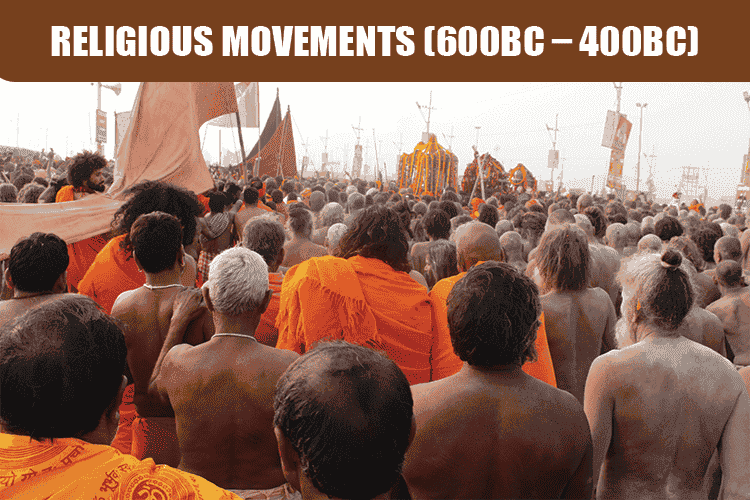
The period between 600 and 400 BCE is considered a crucial period in Indian history and saw the rise of Buddhism, Jainism, and various other sects. These sects rose against the Vedic rituals and priestly order of the time, which were based on simplicity, non-violence and spiritual knowledge
1. Where did Gautama Buddha deliver his first sermon, known as “Dharma Chakra Pravartan” (i.e., Turning of the wheel of the law)?
Ans: Sarnath. [NDA 2006, CDS 2009]
2. Buddha lived approximately at the same time as –
Ans: Confucius. [RRB Mumbai Supervisor/IESM 2006]
3. Which is the sacred book of the Buddhists?
Ans: Tripitaka. [SSC Grad. 2005, RRB Mumbai Supervisor/IESM 2006]
4. Who was the author of “Buddha Charita”?
Ans: Asvaghosha. [SCRA 2005, WB PCS (P) 2008]
5. Name the clan Buddha belonged to –
Ans: Sakya. [SSC Grad, 2008]
6. Buddha’s preachings were mainly related to –
Ans: Purity of thought and conduct. [RRB Mumbai Supervisor/IESM 2006]
7. Buddha means –
Ans: The enlightened one. [SSC Sec. off (Aud.) 2006]
8. The third vehicle in Buddhism was known as –
Ans: Vajrayana. [RRB Mumbai Supervisor/IESM 2006]
9. Where has the world’s largest monolithic statue of Buddha been installed?
Ans: Bamiyan. [SSC Grad, 2008]
10. Which state is called the “cradle of Buddhism”?
Ans: Uttar Pradesh. [Indraprasth Univ. (Delhi)]
11. Where did Lord Buddha breathe his last (Mahaparinirvan)?
Ans: Kushinagar. [SSC Grad. 2001, NDA 2009]
12. Term and its meaning are written below:
Ans:
|
Term |
Meaning/Explanation |
|
Abhidhamma Pitak |
Matters of Psychology and Metaphysics |
|
Sutta Pitaka |
Matters of doctrine and ethics |
|
Vinaya Pitaka |
Rules of Monk order |
|
Mahasanghika |
Members of great community |
13. With reference to Indian literary works, what is “Digha Nikaya”?
Ans: An important Buddhist text in Pali. [NDA 2002]
14. Important events and places related to Buddha -
Ans:
|
Events related to Buddha |
Places |
|
Birth of Buddha |
Lumbini |
|
Enlightenment |
Bodh Gaya |
|
First sermon |
Sarnath |
|
Death of Buddha |
Kushinagar |
15. Which are the branches of Buddhist literature?
Ans: Pitakas and Jataka. [CDS, 2006]
16. In Buddhism, what does “Patimokkha” stand for?
Ans: The rules of the sangha. [CDS, 2009]
17. The first Buddhist council was held in which city?
Ans: Rajgriha. [44th BPSC, 2001]
18. Gautama Buddha was elevated to the position of God by the time of –
Ans: Kanishka. [45th BPSC, 2002]
19. Where was the third Buddhist council held?
Ans: Pataliputra. [46th BPSC, 2004]
20. Buddha was born at –
Ans: Lumbini. [UP PCS (P), 2002]
21. The Lumbini as the birthplace of Buddha is attested by an inscription of –
Ans: Ashoka. [UP PCS, 2004]
22. Buddha attained “Maha Parinirvana” in the republic of the –
Ans: Mallas. [UP PCS, 2005]
23. Buddhist symbols and their meanings are:
Ans:
|
Symbols |
Meaning |
|
Bodhi Tree |
Enlightenment |
|
Dharma Chakra |
First Sermon |
|
Horse |
Renunciation |
|
Lotus |
Birth |
24. What are the four noble truths preached by Lord Buddha?
Ans:
i) There is suffering;
ii) There is the cause of suffering;
iii) There is cessation of suffering;
iv) There is a path leading to the cessation of suffering.
25. In ancient Indian Buddhist monasteries, a ceremony called “Pavarana” used to be held. It was the –
Ans: Confession by monks of their offenses committed during their stay in the monasteries during the rainy season. [UPSC, 2002]
26. Who amongst the following is known as the “Light of Asia”?
Ans: Lord Buddha. [UH PSC, 2005]
27. The “Tripitaka” was written in –
Ans: Pali. [WB PSC, 2008]
28. The Fourth Buddhist council was convened during the regime of king –
Ans: Kanishka. [WB PSC, 2007; CDS, 2014]
29. Who presided over the Buddhist council held during the reign of Kanishka at Kashmir?
Ans: Vasumitra. [UPSC, 2001]
30. Why did Buddhism start declining in India?
Ans: Buddha was accepted as an incarnation of Vishnu and thus became a part of Vaishnavism. [UPSC, 2010]
31. Which is the common element among Rajagriha, Vaishali, and Pataliputra?
Ans: Places where Buddhist councils were held. [NDA, 2015]
32. Lord Buddha’s image is sometimes shown with the hand gesture called “Bhumisparsha Mudra”. It symbolizes –
Ans:
i) Buddha’s calling of the Earth to witness his victory over “Mara” and to prevent “Mara” from disturbing his meditation.
ii) Buddha’s calling of the Earth to witness his purity and chastity despite temptation.
33. What are the eightfold paths of Buddhism?
Ans:
i) Right Understanding;
ii) Right Thought;
iii) Right Action;
iv) Right Livelihood;
v) Right Effort;
vi) Right Mindfulness;
vii) Right Concentration;
viii) Right Speech.
34. The first discourse of Buddha at Deer Park in Sarnath is called –
Ans: Dharma Chakra Pravartan. [Assistant Grade, 1994]
35. The representation of Buddha as a human figure appeared for the first time in the sculptures found at –
Ans: Mathura.
36. In which language were the original Buddhist religious texts written?
Ans: Pali.
37. Gautama Buddha was brought up by –
Ans: Maha Prajapati.
38. The first Buddhist council was held during the reign of –
Ans: Ajatashatru. [I. Tax & Central Excise, 1991]
39. Ashoka was much influenced by a Buddhist monk called –
Ans: Upagupta.
40. Which Buddhist text lays down the regulations for the management of the sangha and the rule of conduct for monks?
Ans: Vinaya Pitaka.
41. Who was the greatest Buddhist commentator of the Buddhist canonical literature?
Ans: Ashvaghosha. [R.R.B, 1995]
42. The Great Buddhist council in 483 B.C was held at –
Ans: Rajagriha. [Railways, 1994]
43. The extreme form of Ahimsa or non-violence is practiced in –
Ans: Buddhism.
44. Which is the most fundamental difference between Mahayana Buddhism and Hinayana Buddhism?
Ans: Worship of gods and goddesses. [P.C.S, 1991]
45. Buddha was born in the year –
Ans: 567 B.C.
46. Which religion spread in different parts of Asia?
Ans: Buddhism.
47. The Fourth Buddhist council was held at –
Ans: Kashmir (Kundalavana).
48. The famous Indo-Greek king who embraced Buddhism was –
Ans: Menander.
49. “Nirvana” is associated with –
Ans: Buddhism.
50. The introduction of Buddhism into China is traditionally attributed to –
Ans: Kasyapa Matanga.
51. Which places are known for early Buddhist stupas?
Ans:
i) Bharhut [Railways, 1994]
ii) Sanchi
iii) Amaravati
iv) Nagarjuna Konda
52. In which language did Buddha preach?
Ans: Pali.
53. Buddhism became a worldwide religion with the efforts of –
Ans: Ashoka.
54. Buddha attained Nirvana at –
Ans: Kushinagar.
55. During the time of Harshavardhana, a great Buddhist assembly was held at –
Ans: Prayag. [C.D.S., 1994]
56. Buddhist historian Taranath belonged to –
Ans: Tibet. [I.F.S, 1989]
57. Who was the first king to have the image of Lord Buddha inscribed on his coins?
Ans: Kanishka. [Railways, 1992]
58. Buddha has been described as an ocean of wisdom and compassion in –
Ans: Amarakosa.
59. The crux of early Buddhism was –
Ans: Renunciation of desire. [Railways, 1993]
60. In his teachings, the Buddha attacked –
Ans: The Varna system. [C.D.S. 95]
61. The three famous Buddhist sites Ratnagiri, Lalitgiri and Udayagiri are located in which of the states?
Ans: Orissa.
62. Relics of Buddha are preserved in a –
Ans: Stupa.
63. In Buddhist teachings, “nirvana” meant –
Ans: Extinction of craving and desire for existence in all its forms.
64. Ashoka convened the Third Buddhist council at which place?
Ans: Pataliputra.
65. Buddhism became the state religion during the reign of –
Ans: Ashoka. [Assistant Grade, 1993]
66. Buddha died during the reign of –
Ans: Ajatashatru.
67. In which of the fields of activity did Buddhism make maximum contribution?
Ans: Art and Literature.
68. Who is said to have been born and to have passed away on the Vaishakha Purnima day?
Ans: Buddha. [C.D.S, 1994]
69. The Fourth Buddhist council compiled an encyclopedia of Buddhist philosophy called –
Ans: Mahavibhasha Sutra.
70. The introduction of Buddhism into China is traditionally attributed to whom?
Ans: Kashyapa Matanga.
71. The cardinal principle of Buddhism was –
Ans: Doctrine of ahimsa.
72. Buddhism split up into the Hinayana and Mahayana sects at the Buddhist council held during the reign of which king?
Ans: Kanishka.
73. In which country was Buddhism first propagated outside India?
Ans: Sri Lanka.
74. Who converted Kanishka to Buddhism?
Ans: Asvaghosha.
75. In which edict or inscription does Ashoka express his faith in the Buddhist creed?
Ans: Bhabru Edict.
76. Ashoka propagated Buddhism in which countries?
Ans: Burma, Nepal, Sri Lanka.
77. Which language was adopted for preaching in Mahayana Buddhism?
Ans: Sanskrit.
78. Which king was a well-known patron of the Mahayana form of Buddhism?
Ans: Kanishka.
79. In which state was the Nalanda University located in India?
Ans: Bihar. [S.S.C Tax Assist. 2009]
80. Who is also known as “Nigantha Nataputra”?
Ans: Vardhamana Mahavira. [SCRA, 2007]
81. Mahavira was born in 6th century BC at –
Ans: Vaishali. [Bihar SSC LDC 2005]
82. The principle that distinguishes Jainism from Buddhism is the –
Ans: Attribution of a soul to all beings and things. [RRB Mumbai Supervisor/IESM 2006]
83. The religious literature of the Jains at the early stage was written in –
Ans: Ardha Magadhi. [SCRA, 2001]
84. Gandhara school of art came into existence in –
Ans: Mahayana sect. [CPO SI 2002]
85. Who taught the doctrine of “shunyata” (‘shunyavad’)?
Ans: Nagarjuna. [CDS, 2006]
86. Mahavira Jaina breathed his last at –
Ans: Pawapuri. [45th BPSC, 2002]
87. Who was an ardent follower of Jainism?
Ans: Kharavela. [CDS, 2006]
88. Chinese traveller Hiuen – Tsang studied at the university of –
Ans: Nalanda. [45th BPSC, 2002]
89. Who is given the credit of carrying Jainism to south India?
Ans: Bhadrabahu. [CDS, 2008]
90. Where did Gautam Buddha attain enlightenment?
Ans: Mahabodhi Temple at Bodh Gaya.
91. Where was Mahavir Swami born?
Ans: Kundagram. [47th BPSC, 2005]
92. The doctrine of three jewels – Right belief, Right conduct and Right knowledge – is the crowning glory of –
Ans: Jainism. [UP PCS, 2004]
93. Which religion propounded that “destiny determines everything; man is powerless”?
Ans: Ajivakas. [UP PCS, 2006]
94. Vikramshila Mahavihara was established by the ruler of –
Ans: Pala Dynasty. [UP PCS, 2005]
95. “Syadvad” (the theory of “man be”) is a doctrine of –
Ans: Jainism. [Utt. PSC, 2005]
96. The Vikramshila Mahavihara, a great centre of education, was founded by –
Ans: Dharmapala. [WB PSC, 2008; UP PCS, 2014]
97. Name the last “Tirthankara” –
Ans: Mahavira. [WB PSC, 2008]
98. Sarnath is in the state of –
Ans: Uttar Pradesh. [UP PCS, 2004]
99. “Prabhasgiri” is a pilgrim spot of –
Ans: Jains. [UP PCS, 2008]
100. “Ashokaram monastery” was situated at –
Ans: Pataliputra. [UP PCS (M), 2015]
101. Who is said to have become the chief of the Jain Sangh after the death of Mahavira?
Ans: Sudharma. [MP PSC, 2009]
102. Which one among the following sects was associated with Gosala Maskariputra?
Ans: Ajivakas. [NDA, 2015]
103. “Jivaka”, the royal physician of Rajgriha, was the son of the “Ganika” named –
Ans: Salavati. [MP PSC, 2009]
104. “Anekantavada” is a core theory and philosophy of which religion?
Ans: Jainism. [UPSC, 2009]
105. Who, according to Jainism, was the founder of Jainism?
Ans: Parsavanatha. [I. Tax & Central Excise, 1991]
106. The famous ruler of ancient India who, towards the end of his life, is said to have converted to Jainism?
Ans: Chandragupta Maurya.
107. Which doctrine is said to have been added by Mahavira to the four other doctrines propounded by previous teachers?
Ans: Observe brahmacharya. [I.E.S. 1993]
108. With which religion is kaivalya associated?
Ans: Jainism.
109. In India, Jainism spread during the reign of –
Ans: Chandragupta Maurya.
110. The distinct line of demarcation between Digambaras and Shvetambaras is about –
Ans: Wearing of dress.
111. Jainism was divided into two sects known as –
Ans: Svetambara and Digambara. [N.D.A. 1995]
112. Apabhramsa is a work of the –
Ans: Jains.
113. “Atman is everything and everything is Atman” is the doctrine of which religion?
Ans: Pantheistic.
114. The last of the 24th Jain Tirthankaras was –
Ans: Mahavira. [C.B.I, 1994]
115. Which city is known as Jain Temple city?
Ans: Girnar.
116. Which rulers held a religious assembly at Prayag every five years?
Ans: Harshavardhana. [Central Excise, 1993]
117. Which place was famous as a seat of Mahayana learning?
Ans: Nalanda. [CDS, 1992]
118. Idol worship in India can be traced to the period of –
Ans: Pre-Aryan. [Assistant Grade, 1990]
119. Which is said to be the oldest Jaina scripture?
Ans: Twelve Angas. [P.C.S, 1995]
120. Who is referred to as “Sadhu From the West”?
Ans: St. Thomas.
121. The original teachings of Mahavira are contained in which texts?
Ans: Purvas.
122. Which period is referred to as the period of Hindu revival or renaissance?
Ans: Gupta Period.
123. The first council of Jainism to compile the canon was held at –
Ans: Pataliputra.