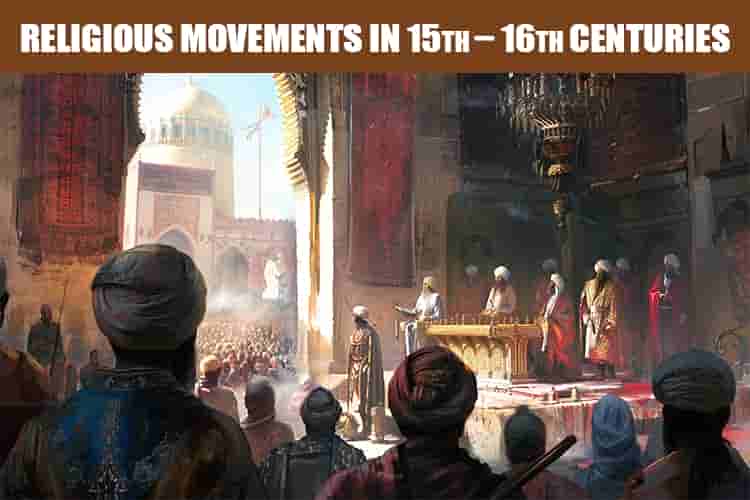
The Bhakti movement of medieval India, with leaders like Ramananda, Ramanuja, Kabir, Mirabai, Chaitanya, Surdas, Namdev, Tukaram, Vallabhacharya, and Basava, emphasized the use of local languages, equality before God, devotion to Krishna, and rejection of caste barriers, along with their doctrine of Susuddhatva and Bidveshi, etc. Nirguna Bhakti.
Bhakti Movement
1. Bhakti movement was started by –
Ans:- Alwar saints. [UP PCS (P), 2003]
2. Which one gives equal importance to Jnana, Karma and Bhakti as a means of liberation?
Ans:- Bhagvad Gita. [UP PCS (M), 2005]
3. Who was the first Bhakti saint to use Hindi for the propagation of his message?
Ans:- Ramananda. [UPSC, 2002]
4. Saints and their respective cults are written below –
Ans:-
|
Saint |
Cult |
|
Shankardeva |
EK-Sharan Dharma |
|
Jagjivan |
Satnami |
|
Lalgir or Lalbeg |
Alakhnami |
|
Gobinda Prabhu |
Mahanubhava Panth |
5. A common feature to all Bhakti saints was that they –
Ans:- Composed their verses in the languages understood by their followers.
6. Who was the Hindu saint to have as disciple both Hindus and Muslims?
Ans:- Sri Chaitanya. [WB PSC (P), 2007]
7. Kabir was the disciple of –
Ans:- Ramananda. [Bihar SSC LDC, 2005]
8. Which philosophy is called the Advaita?
Ans:- Shankaracharya. [CDS, 2009]
9. “Gita Gobinda” the famous poem was written by –
Ans:- Jayadeva. [SSC Sec. off (Aud), 2006]
10. Who was the saint of the Varkari Sect?
Ans:- Namadeva. [UP PCS (M), 2004]
11. Who founded the four mathas (i.e., monasteries) in the four corners of India?
Ans:- Shankaracharya. [RRB Mumbai Supervisor/ IESM, 2006]
12. The mystic poet Mira Bai was –
Ans:- One of the wives of a Rajput ruler. [RAS/ RTS, 2003]
13. Which philosophical system was founded by Vallabh Acharya?
Ans:- Suddhadvaita Vedanta. [CDS, 2008]
14. Bhakt Tukaram was a contemporary of which Mughal emperor?
Ans:- Jahangir. [UPSC, 2006]
15. Sri Perumbudur, a temple town in south, is the birth place of –
Ans:- Ramanuja. [Bank P.O, 1994]
16. The pioneer in preaching Nirguna Bhakti in medieval India was –
Ans:- Ramananda. [C.D.S, 1993]
17. Who was an exponent of Virashaiva?
Ans:- Basavaraja.
18. The saint from Gujarat who preached non-sectarianism in medieval times was –
Ans:- Dadu.
19. The philosophy of Vishishtadvaita was preached by –
Ans:- Ramanuja.
20. Which Acharyas is regarded as having combated the absolute monism of Sankara in the 12th century?
Ans:- Ramanuja.
21. Which Vedas were translated in Hindi by Swami Dayanand?
Ans:- Rig Veda and Yajur Veda.
22. Who was a blind poet who worshipped Krishna and spread Krishna Bhakti cult?
Ans:- Surdas.
23. “In him within whose heart is truth both God Himself abide”, said –
Ans:- Kabir.
24. The Bhakti Movement was first organized by –
Ans:- Ramanuja.
25. “Let no man ask a man’s sect or caste”. Whose dictum was this?
Ans:- Ramananda.
26. Suddhadvaita is the philosophy of –
Ans:- Vallabha.
27. In the systems of philosophy created by Indians, we find elements of materialistic philosophy in which of the following systems?
Ans:- Samkhya. [Railways, 1992]
28. Banis were the hymns and poems composed by –
Ans:- Dadu.
29. Who was the founder of Vaishnava school?
Ans:- Ramanuja.
30. Which are the principles of the Bhakti movement of the 16th century?
Ans:-
a) True devotion is the means of attaining God.
b) Man’s equality before God.
c) Respect for mankind.
31. Who wrote “Chaitanya Charitamrita”?
Ans:- Krishnadas Kaviraj.
32. The system of philosophy with which the name of Kapila is prominently associated is?
Ans:- Samkhya. [I.E.S, 1993]
33. The Bhakti literature by the Nayanmars and Alvars –
Ans:- Preached personal devotion to God as a means of salvation. [C.D.S, 1995]
34. “Live well, as long as you live. Live well even by borrowing, for once cremated, there is no return”, this rejection of afterlife is an aphorism of the –
Ans:- Sunyavada of Nagarjuna. [I.A.S, 1994]
35. Devotion to Lord Krishna was preached by –
Ans:- Vallabha.
36. The author of Sri Bhashya is –
Ans:- Ramanuja.
37. Who said “Ram and Rahim are the two different names of the same God”?
Ans:- Kabir.
38. Philosophies and their founders are written below –
Ans:-
|
Philosophy |
Founder |
|
Samkhya |
Kapila |
|
Yoga |
Patanjali |
|
Nyaya |
Gautami |
|
Purva Mimamsa |
Jamini |
|
Madhyamika |
Nagarjuna |
|
Advaita Philosophy |
Sankara |
39. Various sects and their founders are written below –
Ans:-
|
Sects |
Founder |
|
Ajivika Sect |
Makkhali Gosala |
|
Pasupata Sect |
Lakulisho |