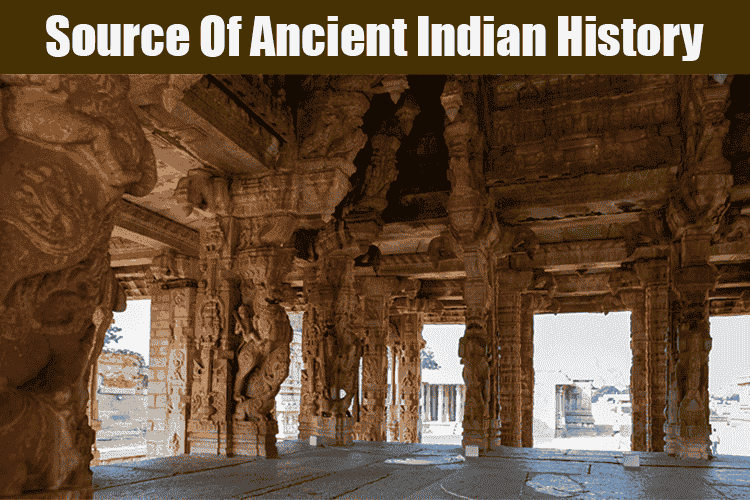
Learn about the major sources of ancient Indian history, their importance and how they help in understanding India's past. Useful for competitive exams and general knowledge
Ans:- Historian Vincent Smith called India as “ethnological museum “.
Ans : - As per Vincent Smith India offers “Unity in diversity “ . That’s why India is called ‘epitome of the world’.
Ans:- Study of inscription is called Epigraphy.
Ans:- Persian geographer Ibn Khordadbeh wrote the geography text “ Kitabul Masalik Wal Mamalik.
Ans:- Merutunga wrote Prabandha Chintamoni.
Ans:- “ Adbhut Sagar “ was written by Ballala sena , a king of the sena dynesty.
Ans :- Megasthenes wrote “ Indica”.
Ans:- State theory is found in “ Arthasashtra”.
Ans:- Information about “ Aryans” found in “Bhogazkoi”.
Ans:- In “ Eran inscription” first reference of “ sati” is found.
Ans:- Goutamiputra Satakarni .
Ans. Numismatics.
Ans:- 711 hymns.
Ans.- 108 Upanishads.
Ans:- Atharva Veda.
Ans:- Atharva Veda.
Ans:- Dipavansa, Mahavansa.
Ans:- Nagsena.
Ans:- Purva.
Ans:- Vallabhi.
Ans:- Hemchandra .
Ans:- Second Shunga King.
Ans:- Chandbardai.
Ans:- Vatsayan.
Ans:- Susrut Samhita.
Ans:- Nitisara.
Ans:- Harisen .
Ans:- 1549 hymns.
Ans:- Cosmas Indicopleustes.
Ans:- Muruj –ul-zahab.
Ans:- Huijiao .
Ans:- Candragomin (Chandra), a Buddhist scholar .
Ans:- “ Mudraraksasa” and” Devichandraguptam”.
Ans:- In the Gupta Period under the reign of Chandra gupta-II.
Ans:- Kalidasa.
Ans:- Dandin.
Ans:- 10th century Jain poet and writer pampa . He is also called Adikavi.
Ans:- 33 lines.
Ans:- The Tirukkural, also known as the kural is a classic Tamil text. It is a collection of 1330short couplets(Kurals).It is divided into three books on virtue, wealth and love.
Ans:- Bharavi.
Ans:- Mitakshara is a treatise on ancient Hindu law of inheritance.
Ans:- Dayabhaga is a hindu law treatise. As per Dayabhaga the sons do not acquire any interest by birth in ancestral property . Father is the sole ruler of all property, both ancestral and personal.
Ans:- Jimutavahana.
Ans:- Gupta dynesty.
Ans:- Varahamihira wrote ” Brihat Jataka” a test book on vedic astrology.
Ans:- The Indian poet and dramatist Rajasekhara.
Ans:- Aryabhatta introduced zero in 5th century but Brahmagupta introduced zero in mathematical calculation like addition and subtraction in 7th century.
Ans:- Bhavabhuti .
Ans:- Brahmagupta.
Ans:- Ksemendra ( Scholar from Kashmir).
Ans:- Acharya Vagbhata.
Ans:- Padmagupta also known as parimala kalidasa( Paramara Court Poet ).
Ans:- The Mahabharata is known as “ Satasaharsri Samhita” ( hundred thousand verses).
Ans:- The Mahabharata.
Ans:- Dasavatar temple is situated in Deogarh, Lalitpur district, Uttar Pradesh in the Betwa river valley.It belongs to the Gupta Period This temple is dedicated to Lord Krishna .
Ans:- Mahakhatrapa Rudradamana.
Ans:- Jayadeva.
Ans:- Rajtarangiri by kalhana.
Ans:- Pala emperor Dharmpala.
Ans:- Vasubandhu.
Ans:- Harshvardhana.
Ans:- Naganika, the queen of satakarni I. It is the valuable sources of satavahana dynesty.
Ans:- In 1837, James Prinsep,a Brish Scholar, deciphered the Ashokan inscription which is written in Brahmi Script.
Ans:- “Yoga Darshan” also known as “Yoga Sustras” was written by patanjali.
Ans:- Somadeva.
Ans:- In Bhabra (or Bairat) Minor Rock Edict,Ashoka expressed his trust in Buddha,Dhamma and Sangha.
Ans:- Pallava king Mahendravarman I.
Ans:-Kushan Dynesty.
Ans:- The ninth mandala of the Rig veda.
Ans:- The Hindu sage kanada, also known as kashyapa.
Ans:- The Purush Shukta” is a notable hymn in the Rigveda. It describes the “Cosmic Being” (Purusha) and the universe is created from the parts of the Purusha’s body. Diffrent parts of the body represents different aspects of the cosmos and society. It also mentions four varnas (Brahmin,Kshatriya,Vashaya,Sudra)of indian socity.
Ans:- Kapil.
Ans:- Kalpa is a vast cyclical perod of time. Sometimes it is described as a “day of Brahma” or a complete cosmic cycle from creation to destruction and recreation.
Ans:- Aksapada Gautama.
Ans:- Nirukta is one of the six Vedangas. It means “explanation” or “ etymology”. It is focusing on the linguistic analysis and interpretation of Sanskrit words.
Ans:- Charudatta.
Ans:- Satavahana King Hala.
Ans:- 11th century Kashmiri poet Bilhana.
Ans:- Gunadhya.
Ans:- Vedic Scholar Halayudha.
Ans:- Bharata Muni.
Ans:- Nagasena wrote “Milind Panho” in pali language.
Ans:- Dignaga.