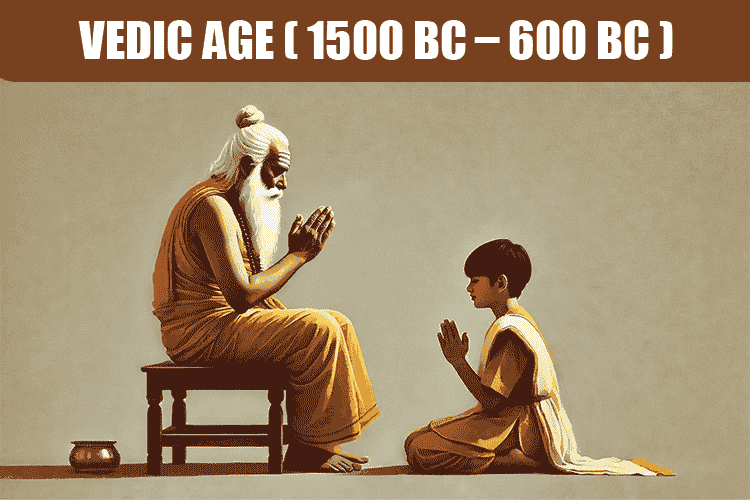
The Vedic period lasted from 1500 BCE to 600 BCE. It arose after the decline of the Indus Valley Civilization. Learn about its culture, society, and significance in Indian history.
1. “Patanjali” is well-known for the compilation of –
Ans: Yoga Sutra. [CDS 2001, SSC 2014]
2. Upanishad are books on –
Ans: Philosophy. [UP PCS, 2002; UP PCS, 2004]
3. Who was the first European to designate Aryan as a race?
Ans: Max Muller. [SSC Grad. 2006]
4. Who wrote Sanskrit Grammar?
Ans: Panini. [SSC Sec.off.2010]
5. Which is the major impact of Vedic culture on Indian History?
Ans: Rigidification of caste system. [RRB Mumbai Supervisor]
6. The staple food of the Vedic Aryan was –
Ans: Milk and its products.
7. Name of the rivers which has mentioned in Rig Veda?
Ans: Sidhu, Saraswati, Yamuna.
8. What are the stages of the life of man in Aryan Society? Or Which was also the usage of post Vedic development?
Ans: Brahmachariya – Grihastha – VanaPrastha – Sanyasa. [I.A.S, 1994]
9. In which language was the “Srimad Bhagavad Gita” originally written?
Ans: Sanskrit. [RRB Mumbai Supervisor/ IESM, 2006]
10. The battle of Mahabharata is believed to have been fought at Kurukshetra for –
Ans: 18 Days. [SSC Tax Assit, 2004]
11. “Purushasukta” is found in the –
Ans: Rig-Veda. [RRB Mumbai Supervisor/ IESM, 2006]
12. Which is the distinctive feature between a “nastika” and “astika” system in India?
Ans: Belief in existence of God. [UP PCS(M) 2005]
13. The God who is the most prominent in “Rig-Veda” is –
Ans: Indra. [CDS 2001, SSC (CGL)2017]
14. The word “Gotra” occurs for the first time in –
Ans: Rig-veda. [UP PCS, 2005]
15. The words “Satyameva Jayate” in the state Emblem of India have been adopted from which one of the Upanishad?
Ans: Mundak Upanishad. [UP PCS 2004, CDS 2006, RRB 2008]
16. The Rigvedic God Varuna was –
Ans: Guardian of the cosmic order. [CDS 2002]
17. The great law giver of ancient times was –
Ans: Manu. [UP PCS, 2004]
18. “Nivi”, “Paridhan” and “Adhivasa” were the –
Ans: Different types of garments of the Aryans. [CDS 2005]
19. The hymns of “Rigveda” are the work of –
Ans: Many authors.
20. The expounder of Yoga Philosophy was –
Ans: Patanjali. [UP PCS, 2002, UP PCS, 2007]
21. The Government of India has decided to declare which rivers as “National River”?
Ans: Ganga. [Canara Bank PO, 2009]
22. Panini, the first Grammarian of Sanskrit language in India, lived during the –
Ans: 6th–5th century BC.
23. “Naya Darshan” was propagated by –
Ans: Gautama. [UP PCS (M), 2005]
24. In the early Rigvedic period, what was considered to be the most valuable property?
Ans: Cow. [UP PCS (M), 2015]
25. Author of “Nayaya Sutra” was –
Ans: Gautam. [RAS / RTS 2008]
26. The Earliest settlement of Aryan tribes were at –
Ans: Sapta Sindhu. [SSC CGL 2014]
27. “Ashtadhyayi” was written by –
Ans: Panini. [UP PCS 2006, RAS/ RTS 2008]
28. Sarga, Pratisarga, Vansa, Manvantara and Vanshanucharit are the indicators of –
Ans: Puranas.
29. The word “Aryan” means –
Ans: Of good family. [WB PCS 2008]
30. The literal meaning of the word “Arya” is –
Ans: Superior. [UP PCS 2007]
31. The religion of early Vedic Aryan was primarily of –
Ans: Worship of nature and Yajnas. [UPCS, 2012]
32. The “Many Smriti” mainly deals with –
Ans: Law. [UPCS, 2007]
33. “Purushmedha” i.e Male sacrifice is referred to in –
Ans: Shatapatha Brahman. [UP PCS, 2008]
34. Which one of the four Vedas contains an account of magical charms and spells?
Ans: Atharvaveda. [UPSC, 2004]
35. Who composed the “Gayatri Mantra”?
Ans: Vishwamitra. [Utt PCS, 2008]
36. The institution of Varna appeared in the –
Ans: Rig Vedic Period. [I.E.S, 1993]
37. Which Veda contains the Gayatri Mantra?
Ans: Rig Veda.
38. Which one was the main characteristic of the Later Vedic Age?
Ans: Caste System. [N.D.A 1990]
39. Which is the oldest Veda?
Ans: Rig Veda.
40. The Vedic deity Indra was the god of –
Ans: Rain & Thunder. [N.D.A 1991]
41. 800 B.C – 600 B.C is designated as the –
Ans: Period of Brahmans.
42. Which were the chief features of Rig-Vedic religion?
Ans: Performance of sacrifices.
43. What was the main difference between the Indus valley civilization and Vedic civilization?
Ans: Indus valley civilization was urban, whereas the Vedic civilization was rural. [Railways, 1991]
44. Which among the following is the source of information about early Vedic period?
Ans: Rig-Veda. [Transmission Executives Exam, 1992]
45. The word “Vid” from which “Veda” has been derived means –
Ans: Knowledge.
46. The Rig Veda consists of how many hymns?
Ans: 1028.
47. The Vishnu purana gives an account of which dynasty?
Ans: Mauryan dynasty.
48. What was the basis of class differentiation among Aryan?
Ans: Colour. [C.R.P.F, 1990]
49. The ninth mandala of the Rig veda samhita is devoted wholly to –
Ans: “Soma” and the god who is named after the drink.
50. Which ideal is not contained in the Atharva Veda?
Ans: Moksha.
51. In Rig Vedic society, which was unknown?
Ans: Purdah system. [Engineering Service, 1992]
52. In Rig Vedic society, which system prevailed?
Ans: Polygamy, Polyandry, child marriage.
53. The chief characteristic of the Rig Vedic religion was –
Ans: Performance of sacrifices. [Assistant Grade, 1991]
54. Some Vedic texts and their contents are written below –
Ans:
|
Vedic text |
Context |
|
i) Manu Smriti |
Code of law. |
|
ii) Sutras |
Customs and rituals |
|
iii) Upvedas |
Secular Subjects. |
|
iv) Brahmans |
Explanatory notes on Vedic mantras. |
55. The god not worshipped during the time of Rig Vedic Aryan was –
Ans: Shiva. [Asstt. Grade, 90]
56. The family of the Rig Vedic Aryan was –
Ans: Patriarchal.
57. The ritualistic precepts attached to the hymns of the Vedas were known as the –
Ans: Brahmans.
58. The Gayatri Mantra contained in the Rig Veda is dedicated to which deity?
Ans: Savitri.
59. Which of the following Vedas is rendered musically?
Ans: Sama Veda. [I.A.S, 1988]
60. Which is the most important divinity of Rig-Veda?
Ans: Varun.
61. The classical Indian music has its origin in which of the following?
Ans: Sama Veda. [Bank P.O, 1992]
62. The Aryan at first settled in –
Ans: Punjab. [C.B.I, 1990]
63. The code of conduct of the Vedic society was laid out in which of the following texts?
Ans: Smritis.
64. The Aryans came to India from –
Ans: Central Asia.
65. Vedas and their contents are written below –
Ans:
|
Veda |
Contents |
|
i) Rig Veda |
Hymns and Prayers. |
|
ii) Sama Veda |
Musical hymns. |
|
iii) Yajur Veda |
Hymns and rituals. |
|
iv) Atharva Veda |
Charms and spells. |
66. Rig Veda samhita devotes one fourth of its hymns to –
Ans: Indra.
67. The salient feature of Rig Vedic religion was the worship of –
Ans: Nature.
68. “Brahmans” are books that deal with –
Ans: Ritualism.
69. Ayurveda owes its origin to –
Ans: Rig Veda.
70. The term “nishka”, which meant an ornament in the Vedic period, was used in later times to denote a –
Ans: Coin. [I.A.S, 1993]
71. Which craftsmanship was practised by the Aryans?
Ans: Pottery, Jewellery, Carpentry.
72. The Puranas contain –
Ans: Thoughts on the mystery of life and universe. [Teachers’ Exam,1993]
73. Which was the God of animal during the later Vedic period?
Ans: Rudra.
74. Boghazkoi is important because –
Ans: Inscriptions found here mention the names of Vedic gods and goddesses. [Teachers’ Exam,1994]
75. The chief impact of Vedic culture on Indian history was the –
Ans: Consolidation of caste system.
76. Puranas dealt with which subjects?
Ans: Primary creation, Secondary creation, Genealogies of gods.
77. Which yajnas were performed during the Vedic age?
Ans:
i) Asvamedha Yajna.
ii) Rajasurya Yajna.
iii) Vratyastama Yajna.
78. Rig-Veda is divided into 10 books. Which books are the oldest?
Ans: Second and seventh books.