
Introduction
Located in Northwestern borders of India, this place traditionally known as the “Land of Five Rivers” is named after the two Persian words: Panj (five) and Aab (water), indicating the Sutlej, Beas, Ravi, Chenab, and Jhelum rivers. As a very important place in the country’s border, it acts as one of the key regions in terms of defence.
This state is often referred to as the “Granary of India” and the “Breadbasket of the Nation” because in the sixties, the region became the main focus for the Green Revolution due to highly fertile alluvial plains and a developed canal system. However, not only agriculture but the state has rich history and has been considered the centre of the Indus Valley Civilization, Vedic Culture and Sikhism. With historical sites such as Golden Temple (Sri Harmandir Sahib) and Jallianwala Bagh in Amritsar, the region has been considered very significant culturally.
State Nicknames of Punjab
Date of Formation of Punjab
History of Punjab
The history of Punjab starts with the establishment of the ancient Indus Valley Civilization at Ropar and the composition of early religious texts during the Sapta Sindhu era. It is located as the northwestern doorway to India as a result, the region faced several invasions for centuries until an era of transformation began with the emergence of Sikhism in the 15th Century by Guru Nanak Dev Ji. In order to fight against the oppression of the ruling empire, Guru Gobind Singh Ji formed the Khalsa Panth in 1699, paving the way for Maharaja Ranjit Singh to bring the independent Sikh Empire in 1799, which was later annexed by the British in 1849.
During the freedom movement, there were some important nationalistic uprisings characterized by the infamous Jallianwala Bagh Massacre (1919) and revolutionary heroes such as Bhagat Singh. The region suffered from the painful partition of 1947 and was then reorganized on the basis of language in 1966.
Geographical Location of Punjab
Boundaries
Strategic Location
Climate at a Glance
State Day of Punjab
Capital of Punjab
PIN Code Prefix of Punjab
Area of Punjab
Area-Wise Rank of Punjab
Population of Punjab
Population Rank of Punjab
Population Density
Sex Ratio
Literacy Rate
According to the latest Punjab Economic Survey and recent Periodic Labour Force Surveys (PLFS), Punjab has seen steady educational growth from its 2011 baseline. The baseline census literacy rate breakdown for the state's population stands at:
Scheduled Caste and Scheduled Tribe Population
Universities of Punjab
|
S.No. |
University |
Location |
|
1 |
Central University of Punjab |
Bathinda |
|
2 |
Guru Nanak Dev University |
Amritsar |
|
3 |
Punjabi University |
Patiala |
|
4 |
Punjab Agricultural University |
Ludhiana |
|
5 |
I. K. Gujral Punjab Technical University |
Kapurthala / Jalandhar |
|
6 |
Maharaja Ranjit Singh Punjab Technical University |
Bathinda |
|
7 |
Baba Farid University of Health Sciences |
Faridkot |
|
8 |
Guru Angad Dev Veterinary & Animal Sciences University |
Ludhiana |
|
9 |
Rajiv Gandhi National University of Law |
Patiala |
|
10 |
Guru Ravidas Ayurved University |
Hoshiarpur |
|
11 |
Jagat Guru Nanak Dev Punjab State Open University |
Patiala |
|
12 |
Maharaja Bhupinder Singh Punjab Sports University |
Patiala |
|
13 |
Shaheed Bhagat Singh State University |
Firozpur |
|
14 |
Sardar Beant Singh State University |
Gurdaspur |
|
15 |
Thapar Institute of Engineering and Technology (Deemed) |
Patiala |
|
16 |
Sant Longowal Institute of Engineering & Technology (Deemed) |
Longowal (Sangrur) |
|
17 |
Lovely Professional University |
Phagwara (Kapurthala) |
|
18 |
Chandigarh University |
Mohali (SAS Nagar) |
|
19 |
Chitkara University |
Rajpura (Patiala) |
|
20 |
DAV University |
Jalandhar |
|
21 |
CT University |
Ludhiana |
|
22 |
Desh Bhagat University |
Mandi Gobindgarh (Fatehgarh Sahib) |
|
23 |
Guru Kashi University |
Talwandi Sabo (Bathinda) |
|
24 |
GNA University |
Phagwara (Kapurthala) |
|
25 |
Akal University |
Talwandi Sabo (Bathinda) |
|
26 |
Adesh University |
Bathinda |
|
27 |
Rayat Bahra University |
Mohali (SAS Nagar) |
|
28 |
RIMT University |
Mandi Gobindgarh |
|
29 |
Sri Guru Granth Sahib World University |
Fatehgarh Sahib |
|
30 |
Sri Guru Ram Das University of Health Sciences |
Amritsar |
|
31 |
Plaksha University |
Mohali (SAS Nagar) |
|
32 |
Lamrin Tech Skills University |
Railmajra (Rupnagar) |
|
33 |
Amity University |
Mohali (SAS Nagar) |
|
34 |
C.G.C. University |
Mohali (SAS Nagar) |
State Symbols of Punjab
Religion in Punjab (Census 2011)
Official Languages of Punjab
Other Languages Spoken
Legislative of Punjab
Legislative Assembly
Judicature of Punjab
Dance Forms of Punjab
Folklore of Punjab
Number of Districts of Punjab with Headquarters
|
S.No. |
District |
Headquarters |
Established |
Area (sq. km.) |
Population (2011) |
Population Density (per sq. km.) |
|
1 |
Amritsar |
Amritsar |
1947 |
2,647 |
2,490,891 |
932 |
|
2 |
Barnala |
Barnala |
2006 |
1,410 |
596,294 |
419 |
|
3 |
Bathinda |
Bathinda |
1948 |
3,385 |
1,388,859 |
414 |
|
4 |
Faridkot |
Faridkot |
1972 |
1,469 |
618,008 |
424 |
|
5 |
Fatehgarh Sahib |
Fatehgarh Sahib |
1992 |
1,180 |
599,814 |
508 |
|
6 |
Fazilka |
Fazilka |
2011 |
3,113 |
1,180,483 |
379 |
|
7 |
Firozpur |
Firozpur |
1833 |
2,190 |
965,337 |
440 |
|
8 |
Gurdaspur |
Gurdaspur |
1852 |
2,635 |
2,299,026 |
872 |
|
9 |
Hoshiarpur |
Hoshiarpur |
1849 |
3,365 |
1,582,793 |
466 |
|
10 |
Jalandhar |
Jalandhar |
1846 |
2,632 |
2,181,753 |
831 |
|
11 |
Kapurthala |
Kapurthala |
1948 |
1,632 |
817,668 |
501 |
|
12 |
Ludhiana |
Ludhiana |
1846 |
3,767 |
3,487,882 |
975 |
|
13 |
Malerkotla |
Malerkotla |
2021 |
837 |
452,016 |
540 |
|
14 |
Mansa |
Mansa |
1992 |
2,171 |
768,808 |
350 |
|
15 |
Moga |
Moga |
1995 |
2,216 |
992,289 |
444 |
|
16 |
Pathankot |
Pathankot |
2011 |
929 |
676,598 |
728 |
|
17 |
Patiala |
Patiala |
1948 |
3,218 |
1,892,282 |
596 |
|
18 |
Rupnagar |
Rupnagar |
1966 |
1,369 |
683,349 |
488 |
|
19 |
Sahibzada Ajit Singh Nagar |
Mohali |
2006 |
1,093 |
986,147 |
830 |
|
20 |
Sangrur |
Sangrur |
1948 |
2,848 |
1,203,153 |
422 |
|
21 |
Shaheed Bhagat Singh Nagar |
Nawanshahr |
1995 |
1,267 |
614,362 |
478 |
|
22 |
Sri Muktsar Sahib |
Sri Muktsar Sahib |
1995 |
2,615 |
902,702 |
348 |
|
23 |
Tarn Taran |
Tarn Taran Sahib |
2006 |
2,449 |
1,120,070 |
464 |
Important District Facts (Punjab)
Note: The baseline metrics are derived from the official Census of India 2011 records. While the 2011 census initially logged 22 districts (including Pathankot and Fazilka created in mid-2011), the count reached 23 in May 2021 when Malerkotla was formally carved out of Sangrur district.
Interesting Facts:
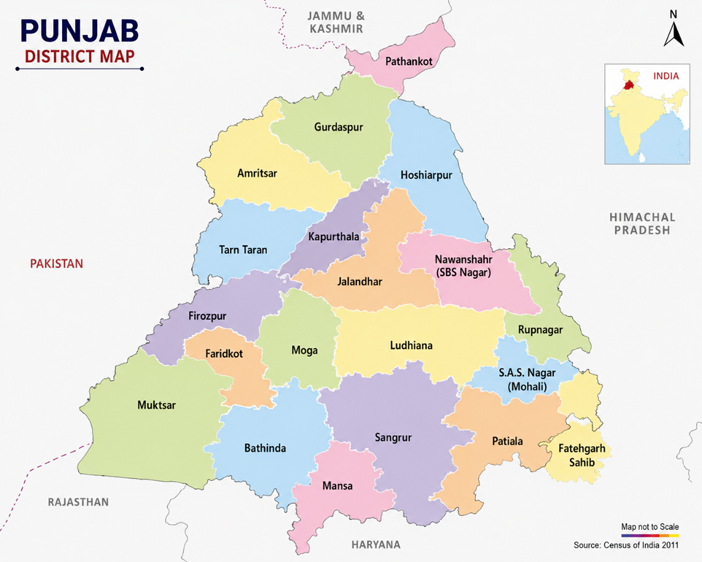
Map of Punjab (District Map)
Sub-Divisions of Punjab
|
S.No. |
District |
District Headquarters |
Key Civil Sub-Divisions (Tehsils) |
|
1 |
Amritsar |
Amritsar |
Amritsar-1, Amritsar-2, Ajnala, Baba Bakala, Majitha, Lopoke |
|
2 |
Barnala |
Barnala |
Barnala, Mehal Kalan, Tapa |
|
3 |
Bathinda |
Bathinda |
Bathinda, Rampura Phul, Talwandi Sabo, Maur |
|
4 |
Faridkot |
Faridkot |
Faridkot, Jaito, Kotkapura |
|
5 |
Fatehgarh Sahib |
Fatehgarh Sahib |
Fatehgarh Sahib, Amloh, Bassi Pathana, Khamanon |
|
6 |
Fazilka |
Fazilka |
Fazilka, Abohar, Jalalabad |
|
7 |
Firozpur |
Firozpur |
Firozpur, Guru Harsahai, Zira |
|
8 |
Gurdaspur |
Gurdaspur |
Gurdaspur, Batala, Dera Baba Nanak, Dina Nagar, Fatehgarh Churian, Kalanaur |
|
9 |
Hoshiarpur |
Hoshiarpur |
Hoshiarpur, Dasuya, Garhshankar, Mukerian, Tanda |
|
10 |
Jalandhar |
Jalandhar |
Jalandhar-1, Jalandhar-2, Adampur, Nakodar, Phillaur, Shahkot |
|
11 |
Kapurthala |
Kapurthala |
Kapurthala, Bholath, Phagwara, Sultanpur Lodhi |
|
12 |
Ludhiana |
Ludhiana |
Ludhiana East, Ludhiana West, Jagraon, Khanna, Payal, Raikot, Samrala |
|
13 |
Malerkotla |
Malerkotla |
Malerkotla, Ahmedgarh, Amargarh |
|
14 |
Mansa |
Mansa |
Mansa, Budhlada, Sardulgarh |
|
15 |
Moga |
Moga |
Moga, Bagha Purana, Dharamkot, Nihal Singh Wala |
|
16 |
Pathankot |
Pathankot |
Pathankot, Dhar Kalan |
|
17 |
Patiala |
Patiala |
Patiala, Dudhan Sadhan, Nabha, Patran, Rajpura, Samana |
|
18 |
Rupnagar |
Rupnagar |
Rupnagar, Anandpur Sahib, Chamkaur Sahib, Morinda, Nangal |
|
19 |
Sahibzada Ajit Singh Nagar |
Mohali |
S.A.S. Nagar (Mohali), Dera Bassi, Kharar |
|
20 |
Sangrur |
Sangrur |
Sangrur, Bhawanigarh, Dhuri, Dirba, Lehra, Moonak, Sunam |
|
21 |
Shaheed Bhagat Singh Nagar |
Nawanshahr |
Nawanshahr, Balachaur, Banga |
|
22 |
Sri Muktsar Sahib |
Sri Muktsar Sahib |
Sri Muktsar Sahib, Gidderbaha, Malout |
|
23 |
Tarn Taran |
Tarn Taran Sahib |
Tarn Taran, Bhikhiwind, Khadur Sahib, Patti |
Number of Villages in Punjab
Number of Blocks
Lok Sabha Seats of Punjab
Major Lok Sabha Constituencies
Rajya Sabha Seats of Punjab
Vidhan Sabha Seats of Punjab
Main Towns of Punjab
Here is the table of the main cities and towns of Punjab with a population above 100,000 as per the 2011 Census:
|
S.No. |
City/Town |
District |
Population (Census 2011) |
|
1 |
Ludhiana |
Ludhiana |
1,618,879 |
|
2 |
Amritsar |
Amritsar |
1,183,705 |
|
3 |
Jalandhar |
Jalandhar |
873,725 |
|
4 |
Patiala |
Patiala |
446,246 |
|
5 |
Bathinda |
Bathinda |
285,813 |
|
6 |
Moga |
Moga |
168,443 |
|
7 |
Mohali (SAS Nagar) |
Mohali |
166,864 |
|
8 |
Batala |
Gurdaspur |
158,404 |
|
9 |
Pathankot |
Pathankot |
147,875 |
|
10 |
Firozpur |
Firozpur |
146,897 |
|
11 |
Abohar |
Fazilka |
145,238 |
|
12 |
Malerkotla |
Malerkotla |
135,238 |
|
13 |
Khanna |
Ludhiana |
128,130 |
|
14 |
Phagwara |
Kapurthala |
117,954 |
|
15 |
Muktsar |
Muktsar |
117,085 |
|
16 |
Barnala |
Barnala |
116,454 |
|
17 |
Rajpura |
Patiala |
112,193 |
|
18 |
Faridkot |
Faridkot |
110,694 |
|
19 |
Hoshiarpur |
Hoshiarpur |
110,091 |
|
20 |
Kapurthala |
Kapurthala |
101,654 |
Main Crops of Punjab
Main Cash Crops of Punjab
Minerals Found in Punjab
Rivers Flowing Through Punjab
Major Perennial Rivers in Modern Punjab (India)
|
S.No. |
River Name |
Total Length (Approx.) |
Origin Point |
Confluence / Endpoint |
Key Significance & Features |
|
1 |
Sutlej (Satluj) |
~1,450 km (~507 km in India) |
Rakshastal Lake, Tibet |
Merges with Indus River at Mithankot (Pakistan) |
Longest river in Punjab; site of Bhakra-Nangal Dam; feeds Indira Gandhi Canal. |
|
2 |
Beas |
~470 km |
Beas Kund, Himachal Pradesh |
Confluences with Sutlej River at Harike |
Flows entirely within India; forms Harike RAMSAR wetland; Alexander's easternmost stop. |
|
3 |
Ravi |
~720 km |
Bara Bhangal, Himachal Pradesh |
Merges with Chenab River (Pakistan) |
Forms ~170 km of India-Pakistan border; runs near Amritsar and Madhopur Headworks. |
Non-Perennial & Seasonal Rivers in Punjab
|
S.No. |
River Name |
Total Length (Approx.) |
Origin Point |
Confluence / Endpoint |
Key Significance & Features |
|
4 |
Ghaggar-Hakra |
~320 km (India) |
Dagshai, Himachal Pradesh |
Dries up in Thar Desert (Rajasthan) |
Seasonal river linked to ancient Vedic Saraswati; drains the Malwa region. |
|
5 |
Chakki River |
~90 km |
Shivalik Hills, Himachal Pradesh |
Confluences with Beas River |
Major seasonal hill torrent flowing through Pathankot district. |
Historical Rivers of Undivided Punjab (Now in Pakistan)
|
S.No. |
River Name |
Total Length (Approx.) |
Origin Point |
Confluence / Endpoint |
Key Significance & Features |
|
6 |
Chenab |
~1,180 km |
Bara Lacha Pass, Himachal Pradesh |
Joins Sutlej to form Panjnad River |
Largest Indus tributary by volume; allocated to Pakistan in 1960 treaty. |
|
7 |
Jhelum |
~725 km |
Verinag Spring, Kashmir Valley |
Merges with Chenab River |
Ancient Hydaspes; site of the historic Battle between Alexander and King Porus. |
Mountains and Hills of Punjab
|
S.No. |
Peak / Hill Range |
Approximate Elevation |
Location (District) |
Cultural & Historical Significance |
|
1 |
Dhar Kalan / Dunera Hills |
500 m – 1,000 m |
Pathankot |
Punjab's highest point; site of ancient Mukteshwar Cave Temple (Pandava legends). |
|
2 |
Anandpur Sahib Foothills |
400 m – 600 m |
Rupnagar |
Location of Takht Sri Keshgarh Sahib; birthplace of the Khalsa Panth (1699). |
|
3 |
Hoshiarpur Shivalik Belt |
350 m – 700 m |
Hoshiarpur |
Known for steep seasonal stream beds (Choes) and the ancient Kamahi Devi Temple. |
|
4 |
Kiratpur Sahib Hills |
350 m – 500 m |
Rupnagar |
Sacred town founded by Guru Hargobind Ji; river site for Sikh funeral rites. |
|
5 |
SBS Nagar Shivalik Spurs |
300 m – 450 m |
Shaheed Bhagat Singh Nagar |
Part of the sub-mountainous Kandi belt; key forest and soil catchment zone. |
|
6 |
Mirzapur / Majri Hills |
300 m – 400 m |
Mohali |
Features the Mirzapur Dam; known for eco-trails and fossil discovery sites. |
Industries of Punjab
Here is the industrial and economic sector profile for Punjab, structured in the exact format and layout of your uploaded reference image:
|
No. |
Sector Type |
Major Economic Activity |
|
1 |
Primary Sector
(Agriculture & Allied) |
|
|
2 |
Secondary Sector
(Manufacturing & Industrial) |
|
|
3 |
Tertiary Sector
(Services) |
|
Major Economic Sectors
Airports in Punjab
|
S.No. |
Airport Name |
Location (District) |
|
1 |
Sri Guru Ram Dass Jee International Airport |
Amritsar |
|
2 |
Shaheed Bhagat Singh International Airport |
Sahibzada Ajit Singh Nagar (Mohali) / Chandigarh |
|
3 |
Adampur Airport (Civil Enclave) |
Jalandhar |
|
4 |
Sahnewal Airport (Ludhiana Airport) |
Ludhiana |
|
5 |
Pathankot Airport (Civil Enclave) |
Pathankot |
|
6 |
Bhisiana Air Force Station / Bathinda Airport (Civil Enclave) |
Bathinda |
|
7 |
Halwara International Airport (Under Construction / Upcoming Civil Enclave) |
Ludhiana |
Major Railway Stations in Punjab
|
S.No. |
Station Name |
Station Code |
Location (District) |
Railway Zone / Division |
Station Type / Status |
|
1 |
Ludhiana Junction |
LDH |
Ludhiana |
Northern Railway / Firozpur |
Major Junction (NSG-2) |
|
2 |
Amritsar Junction |
ASR |
Amritsar |
Northern Railway / Firozpur |
Major Terminus / Border Transit (NSG-2) |
|
3 |
Jalandhar City Junction |
JUC |
Jalandhar |
Northern Railway / Firozpur |
Major Junction (NSG-2) |
|
4 |
Jalandhar Cantonment |
JRC |
Jalandhar |
Northern Railway / Firozpur |
Important Transit Station (NSG-3) |
|
5 |
Bathinda Junction |
BTI |
Bathinda |
Northern Railway / Ambala |
Major Junction / Railway Hub (NSG-3) |
|
6 |
Firozpur Cantonment |
FZR |
Firozpur |
Northern Railway / Firozpur |
Divisional Headquarters / Junction (NSG-3) |
|
7 |
Pathankot Junction |
PTK |
Pathankot |
Northern Railway / Firozpur |
Major Gateway Junction (NSG-4) |
|
8 |
Pathankot Cantonment |
PTKC |
Pathankot |
Northern Railway / Firozpur |
Mainline Transit Station |
|
9 |
Patiala |
PTA |
Patiala |
Northern Railway / Ambala |
District Headquarter Station (NSG-4) |
|
10 |
Phagwara Junction |
PGW |
Kapurthala |
Northern Railway / Firozpur |
Key Industrial Junction (NSG-3) |
|
11 |
Beas Junction |
BEAS |
Amritsar |
Northern Railway / Firozpur |
Award-winning Model Station (NSG-3) |
|
12 |
Dhuri Junction |
DUI |
Sangrur |
Northern Railway / Ambala |
Major Central Railway Junction |
|
13 |
Rajpura Junction |
RPJ |
Patiala |
Northern Railway / Ambala |
Key Industrial Junction |
|
14 |
Sirhind Junction |
SIR |
Fatehgarh Sahib |
Northern Railway / Ambala |
Historic Junction |
|
15 |
SAS Nagar Mohali |
SASN |
Mohali (SAS Nagar) |
Northern Railway / Ambala |
Sub-urban Satellite Station |
|
16 |
Hoshiarpur |
HSX |
Hoshiarpur |
Northern Railway / Firozpur |
Terminal Station |
|
17 |
Moga |
MOGA |
Moga |
Northern Railway / Firozpur |
District Headquarter Station |
|
18 |
Faridkot |
FDK |
Faridkot |
Northern Railway / Firozpur |
District Headquarter Station |
|
19 |
Abohar Junction |
ABS |
Fazilka |
Northern Railway / Ambala |
Key Western Junction (NSG-4) |
|
20 |
Anandpur Sahib |
ANSB |
Rupnagar |
Northern Railway / Ambala |
Major Pilgrimage Station |
|
21 |
Rupnagar |
RPAR |
Rupnagar |
Northern Railway / Ambala |
District Headquarter Station |
|
22 |
Kapurthala |
KXH |
Kapurthala |
Northern Railway / Firozpur |
Industrial & District Station |
|
23 |
Attari |
ATT |
Amritsar |
Northern Railway / Firozpur |
International Border Terminal |
Major Roads and Highways of Punjab
Here is the detailed list of major highways and expressways in Punjab, organized with their route segments within the state and strategic significance:
|
S.No. |
Highway |
Route Segment within Punjab |
Key Strategic Importance |
|
1 |
NH 44 (North-South Corridor / Old NH 1 & 1A) |
Shambhu (Haryana Border) → Rajpura → Khanna → Ludhiana → Phagwara → Jalandhar → Pathankot → Madhopur (J&K Border) |
Primary lifeline connecting North India to J&K; critical for military defense logistics, inter-state trade, and industrial freight. |
|
2 |
NH 3 (Old NH 1 & 70) |
Attari (Indo-Pak Border) → Amritsar → Jalandhar → Hoshiarpur → HP Border |
Connects international border at Attari-Wagah to central Punjab and Himachal Pradesh; vital for border trade, transit, and tourism. |
|
3 |
NH 5 (Old NH 95 & 22) |
Firozpur (Border) → Moga → Jagraon → Ludhiana → Kharar → Mohali / Zirakpur → HP Border |
Key east-west arterial route connecting border districts directly to industrial hubs (Ludhiana) and Chandigarh Tricity. |
|
4 |
NH 7 (Old NH 64 & 10) |
Fazilka → Abohar → Malout → Bathinda → Barnala → Sangrur → Patiala → Zirakpur |
Major southern corridor traversing the Malwa agricultural belt; vital for grain, cotton, and oil transport to neighbor states. |
|
5 |
NH 54 (Old NH 15 - Western Border Highway) |
Pathankot → Gurdaspur → Batala → Amritsar → Zira → Faridkot → Bathinda → Malout → Abohar |
Strategic border-parallel highway running alongside the western frontier; essential for border defense supply and regional trade. |
|
6 |
NH 205 (Old NH 21) |
Kharar → Rupnagar (Ropar) → Kiratpur Sahib → Anandpur Sahib → HP Border |
Major gateway route connecting Punjab plains to Himachal Pradesh; heavily used for pilgrimage (Anandpur Sahib) and timber/mineral freight. |
|
7 |
NH 354 (Border Circuit / Guru Nanak Dev NH) |
Gurdaspur → Dera Baba Nanak → Ajnala → Amritsar → Bhikhiwind → Khem Karan → Firozpur |
Strategic defense and border route running along the IB; connects key border pilgrimage sites including Kartarpur Corridor access (Dera Baba Nanak). |
|
8 |
NH 703 / 703A |
Jalandhar → Nakodar → Moga → Barnala → Mansa → Sardulgarh → HR Border (703A links Kapurthala & Sultanpur Lodhi) |
Core agricultural-industrial connector; links major trade centers in central Malwa to Doaba and Haryana. |
|
9 |
Delhi–Amritsar–Katra Expressway (NE-5 - Upcoming Access-Controlled) |
Traverses Patiala, Sangrur, Ludhiana, Jalandhar, Kapurthala, Gurdaspur, and Amritsar |
High-speed greenfield corridor designed to drastically reduce travel time between Delhi, major Punjab hubs, and Jammu & Kashmir. |
Hydroelectric Power Projects of Punjab
Here is the complete list of hydroelectric power projects in Punjab, presented in tabular format:
|
S.No. |
Project Name |
Installed Capacity (MW) |
River / Stream |
Location (District) |
Status |
|
1 |
Ranjit Sagar Dam HEP (Thein Dam) |
600 MW |
Ravi River |
Pathankot |
Operational |
|
2 |
Mukerian Hydel Project (MHP) Stage-I |
207 MW |
Mukerian Hydel Canal (Beas River) |
Hoshiarpur (Talwara) |
Operational |
|
3 |
Anandpur Sahib Hydel Project (ASHP) |
134 MW |
Anandpur Sahib Hydel Channel (Sutlej River) |
Rupnagar (Anandpur Sahib) |
Operational |
|
4 |
Upper Bari Doab Canal (UBDC) Stage-I & II |
91.35 MW |
UBDC Hydel Channel (Ravi River) |
Pathankot (Madhopur / Sarna) |
Operational |
|
5 |
Shanan Power House |
110 MW |
Uhl River (Tributary of Beas) |
Joginder Nagar (Administered by Punjab) |
Operational |
|
6 |
Shahpurkandi Hydroelectric Project |
206 MW |
Ravi River |
Pathankot (Shahpurkandi) |
Under Construction / Commissioning |
|
7 |
Micro Hydel Projects (Nidampur, Daudhar, Rohti, Thuhi) |
3.9 MW (Combined) |
Canal Falls (Ghaggar & Abohar Branches) |
Patiala, Sangrur, Moga |
Operational |
|
8 |
Mukerian Hydel Project Stage-II |
18 MW |
Mukerian Hydel Canal |
Hoshiarpur |
Proposed / Under Development |
Renewable Thermal Energy Projects of Punjab
|
S.No. |
Project Name |
Installed Capacity (MW) |
Location (District) |
Fuel Type |
Status |
|
1 |
Talwandi Sabo Power Limited (TSPL) |
1,980 MW |
Banawala, Mansa |
Coal (Thermal - IPP) |
Operational |
|
2 |
Nabha Power Limited (NPL) |
1,400 MW |
Rajpura, Patiala |
Coal (Thermal - IPP) |
Operational |
|
3 |
Guru Hargobind Thermal Plant (GHTP) |
920 MW |
Lehra Mohabbat, Bathinda |
Coal (Thermal - State) |
Operational |
|
4 |
Guru Gobind Singh Super Thermal Power Plant |
840 MW |
Ropar (Rupnagar) |
Coal (Thermal - State) |
Operational |
|
5 |
Goindwal Sahib Thermal Power Plant |
540 MW |
Goindwal Sahib, Tarn Taran |
Coal (Thermal - PSPCL/Acquired) |
Operational |
|
6 |
Lehragaga Bio-CBG (Compressed Bio-Gas) Plant |
~12 MW equivalent (33.2 Tonnes/day) |
Lehragaga, Sangrur |
Biomass / Paddy Straw (Renewable) |
Operational |
|
7 |
Jalkheri Biomass Power Plant |
10 MW |
Jalkheri, Fatehgarh Sahib |
Biomass / Rice Straw (Renewable) |
Operational |
|
8 |
Canal-Top Solar Photovoltaic (SPV) Projects |
20 MW (Expanding by 40 MW) |
Canal Banks (Rupnagar / Ludhiana) |
Solar (Renewable) |
Operational |
|
9 |
Malwa Utility Scale Solar Power Plants |
~100 MW |
Fazilka & Sri Muktsar Sahib |
Solar (Renewable) |
Operational |
|
10 |
Bathinda Waste-to-Energy / Bio-Gas Plant |
10 MW |
Bathinda |
Municipal Waste / Bio-Gas (Renewable) |
Operational |
Dams and Reservoirs of Punjab
|
S.No. |
Dam / Reservoir Name |
River / Stream |
Location (District) |
Status |
Key Features |
|
1 |
Ranjit Sagar Dam (Thein Dam) |
Ravi River |
Pathankot |
Operational |
Punjab's largest earth-fill dam; 600 MW hydro capacity. |
|
2 |
Shahpur Kandi Dam |
Ravi River |
Pathankot |
Operational / Commissioning |
Downstream re-regulating dam; 206 MW capacity; stops excess flow to Pakistan. |
|
3 |
Nangal Dam & Reservoir |
Sutlej River |
Rupnagar (Ropar) |
Operational |
Forms Nangal Lake; feeds the Anandpur Sahib and Nangal Hydel Canals. |
|
4 |
Dholbaha Dam |
Dholbaha Khad |
Hoshiarpur |
Operational |
First major low-earth dam in the Kandi region for flood control. |
|
5 |
Siswan Dam |
Siswan Khad |
SAS Nagar (Mohali) |
Operational |
Foothill earth-fill dam providing local irrigation and soil conservation. |
|
6 |
Mirzapur Dam |
Budki Khad |
SAS Nagar (Mohali) |
Operational |
Popular eco-tourism spot; supports foothill village irrigation. |
|
7 |
Chohal Dam |
Chohal Choe |
Hoshiarpur |
Operational |
Built for flood mitigation and regional irrigation; local picnic spot. |
|
8 |
Damsal Dam |
Damsal River |
Hoshiarpur |
Operational |
Earthen check dam regulating seasonal stream runoff. |
|
9 |
Thana Dam |
Khwaja Khad |
Hoshiarpur |
Operational |
Crucial water catchment dam for sub-mountainous dry belts. |
|
10 |
Perch Dam |
Perch Khad |
SAS Nagar (Mohali) |
Operational |
Provides flood protection, wildlife habitat support, and farming water. |
|
11 |
Jainti Dam |
Soonk / Jainti Khad |
SAS Nagar (Mohali) |
Operational |
Controls soil erosion and recharges groundwater in the Shivalik belt. |
|
12 |
Saleran Dam |
Saleran Khad |
Hoshiarpur |
Operational |
Sub-mountainous check dam for flood control and canal irrigation. |
|
13 |
Maili Dam |
Maili Choe |
Hoshiarpur |
Operational |
Traps monsoon runoff to prevent flash floods near Garhshankar. |
|
14 |
Janauri Dam |
Janauri Khad |
Hoshiarpur |
Operational |
Rainwater harvesting and groundwater recharge dam in Kandi region. |
|
15 |
Patiari Dam |
Patiari Khad |
Hoshiarpur |
Operational |
Earthen reservoir managed for soil conservation and local farming. |
Museums in Punjab
Space Research & Science Facilities in Punjab
Pushpa Gujral Science City, Kapurthala
ISRO Regional Academic Centre for Space (RACS), NIT Jalandhar
Wildlife Sanctuaries of Punjab
|
S.No. |
Wildlife Sanctuaries & Tiger Reserves |
District |
Key Wildlife Species |
Notable Features |
|
1 |
Abohar Wildlife Sanctuary |
Fazilka |
Blackbuck, Blue Bull, Wild Boar |
Spreads over private lands; protected by Bishnoi community. |
|
2 |
Harike Lake Wildlife Sanctuary |
Tarn Taran / Firozpur |
Indus Dolphin, Otter, Waterfowl |
Largest North Indian wetland; Ramsar site. |
|
3 |
Nangal Wildlife Sanctuary |
Rupnagar |
Pangolin, Leopard, Migratory birds |
Ramsar site on Bhakra-Nangal reservoir. |
|
4 |
Takhni-Rehmapur Wildlife Sanctuary |
Hoshiarpur |
Barking Deer, Pangolin, Python |
Located in Shivalik foothill ecosystem. |
|
5 |
Jhajjar Bacholi Wildlife Sanctuary |
Rupnagar |
Sambar, Barking Deer, Leopard |
Shivalik eco-corridor near Anandpur Sahib. |
|
6 |
Kathlaur Kushlian Wildlife Sanctuary |
Pathankot |
Hog Deer, Chital, Peafowl |
Dense riverine forest along Ravi River. |
|
7 |
Bir Moti Bagh Wildlife Sanctuary |
Patiala |
Blackbuck, Chital, Quail |
Historic royal hunting reserve (Bir). |
|
8 |
Bir Bhadson Wildlife Sanctuary |
Patiala |
Blue Bull, Blackbuck, Jackal |
Former royal hunting grounds near Nabha. |
|
9 |
Bir Bunerheri Wildlife Sanctuary |
Patiala |
Blackbuck, Blue Bull, Porcupine |
Protected forest with rich native avifauna. |
|
10 |
Bir Dosanjh Wildlife Sanctuary |
Patiala |
Blue Bull, Wild Boar, Peafowl |
Protected forest strip near Nabha road. |
|
11 |
Bir Gurdialpura Wildlife Sanctuary |
Patiala |
Blue Bull, Jungle Cat, Owlet |
Grassland fauna habitat. |
|
12 |
Bir Mehaswala Wildlife Sanctuary |
Patiala |
Blue Bull, Blackbuck, Peafowl |
Royal preserve converted to sanctuary. |
|
13 |
Bir Aishvan Wildlife Sanctuary |
Sangrur |
Blue Bull, Hare, Parakeet |
Central Malwa protected forest strip. |
UNESCO World Heritage Site
Note: UNESCO Tentative List includes Sri Harimandir Sahib (The Golden Temple), Amritsar and sites along the historic Grand Trunk Road.
Festivals of Punjab
Historical Places in Punjab
Famous Food and Cuisine of Punjab
|
S.No. |
Dish |
Short Description |
|
1 |
Sarson Ka Saag & Makki Ki Roti |
Mustard greens curry with cornmeal flatbread and butter. |
|
2 |
Butter Chicken |
Tandoori chicken in a creamy, mild tomato gravy. |
|
3 |
Amritsari Kulcha |
Stuffed, crispy tandoori flatbread served with chole. |
|
4 |
Chole Bhature |
Spicy chickpea curry served with fried fluffy bread. |
|
5 |
Dal Makhani |
Slow-cooked black lentils enriched with butter and cream. |
|
6 |
Amritsari Macchi |
Crispy, spiced gram-flour battered fried fish. |
|
7 |
Tandoori Chicken |
Yogurt-marinated spiced chicken roasted in a clay oven. |
|
8 |
Pinni |
Rich winter sweet made of wheat flour, ghee, and nuts. |
|
9 |
Lassi |
Sweet or salted churned yogurt drink topped with cream. |
|
10 |
Phirni / Kheer |
Slow-cooked rice pudding flavored with saffron and nuts. |
Traditional Dress of Punjab
For Women:
|
Dress |
Description |
|
Phulkari Suit |
Tunic and suit set with silk thread floral embroidery. |
|
Patiala Salwar Suit |
Short tunic paired with heavily pleated, wide trousers. |
|
Ghagra |
Long flared skirt paired with a short tunic and scarf. |
|
Sharara |
Flared wide-legged pants worn with a short tunic. |
For Men:
|
Dress |
Description |
|
Kurta Tehmat |
Long tunic paired with a draped lower garment. |
|
Kurta Pajama |
Long straight-cut tunic paired with fitted trousers. |
|
Sherwani |
Formal long coat worn over a kurta for special occasions. |
|
Pagg / Pagri |
Traditional turban representing honor and pride. |
|
Jutti |
Handcrafted, embroidered leather footwear. |
Tourist Places of Punjab
Natural Attractions
Cultural Attractions
Wildlife Attractions
Political Parties of Punjab
|
Political Party |
Founder(s) |
|
Aam Aadmi Party (AAP) |
Arvind Kejriwal, Prashant Bhushan, Yogendra Yadav, and others |
|
Indian National Congress (INC) |
Allan Octavian Hume, Dadabhai Naoroji, and Dinshaw Wacha |
|
Shiromani Akali Dal (SAD) |
Master Tara Singh, Sarmukh Singh Chubbal, Baba Kharak Singh, and Sikh leaders |
|
Bharatiya Janata Party (BJP) |
Atal Bihari Vajpayee and L. K. Advani |
|
Bahujan Samaj Party (BSP) |
Kanshi Ram |
|
Shiromani Akali Dal (Amritsar) |
Simranjit Singh Mann and allied Sikh factions |
|
Communist Party of India (CPI) |
M. N. Roy, Evelyn Trent, Abani Mukherji, and others |
|
Communist Party of India (Marxist) [CPI(M)] |
E. M. S. Namboodiripad, A. K. Gopalan, Jyoti Basu, and others |
First Governor of Punjab
First Chief Minister of Punjab
Great Personalities of Punjab
Political Leaders
Cultural Personalities
Sports Personalities
Architecture of Punjab
Sports of Punjab
Field Hockey and Kabaddi are deeply ingrained in Punjab's cultural identity, and the state has produced several Olympic legends, world champions, and national-level athletes.
Conclusion
The state of Punjab has a rich cultural background. It is noted for its unique architecture, spirituality, festive occasions, and unravelling history. This particular state is blessed with diverse range of communities that contribute towards keeping alive its heritage and culture.
Punjab is also a place with an active environment, having influential leaders who not only helped build up this beautiful state but also made a significant impact on the entire nation at large, along with some wetlands and sanctuaries. Alongside economic and social growth, Punjab managed to maintain its spiritual and historical significance, and hence it is known as the Land of Five Rivers.