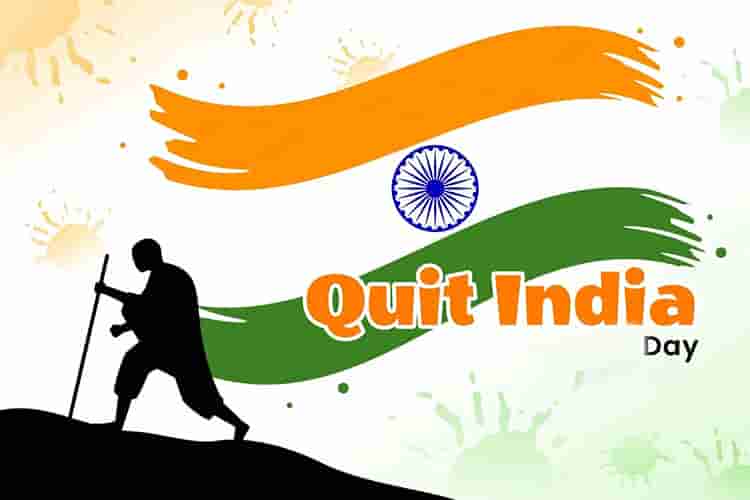
Honoring the Quit India Movement: A Roar for Freedom
Introduction:
The Quit India Movement was one of the most important events in the Indian independence movement. It is also known as "August Kranti Diwas." The movement played an important role as a milestone in India's struggle for independence from British colonial rule. It commemorated the brave actions and sacrifices of the past. The movement began as a response to the immediate end of British rule in India for the success of Indian independence and democracy. The proposal of the movement was primarily a mass protest for the withdrawal of British power in India, which was characterized by civil disobedience, strikes, and nationwide demonstrations.
Table of Contents:
- What is Quit India Day?
- Background of the movement
- Reason of launching quit India movement
- Significance of Quit India Movement
What is Quite India Day?
After the rejection of the Cripps Mission, on 8 August 1942, the All India Congress Committee (AICC) passed the Quit India Resolution at its session held in Bombay. This resolution demanded the immediate end of British rule in India. The movement officially began on 9 August. The slogan "Quit India" became a rallying cry for this mass non-violent movement. 9 August is celebrated every year as Quit India Day, one of the most important events of the Indian independence movement.
Background of the movement:
- After World War II, in April 1942, following the failure of the Cripps Mission, which proposed limited autonomy for the British government, a massive movement began across India, known as the Quit India Movement.
- Mahatma Gandhi, Jawaharlal Nehru, Sardar Vallabhbhai Patel, and many others played an active role in this movement.
- After the passage of this resolution, as an authorization to initiate a non-violent mass struggle for the country's independence, Mahatma Gandhi said in his speech, "Do or die," meaning that either we will become independent or we will die trying.
- Unlike other previous movements, this movement also saw a large participation of students, women, and workers from rural and urban areas.
- This movement, led by Mahatma Gandhi, Jawaharlal Nehru, and Sardar Vallabhbhai Patel, increased pressure on the British government, which eventually led to India's independence in 1947.
- While most of the leaders of the Quit India Movement were arrested and imprisoned, people attacked government property, government institutions, railway lines, and telephones.
Reason of launching quite India movement:
The main reasons why nationalist leaders started the Quit India movement were —
- Failure of the Cripps Mission: The British were reluctant to grant genuine constitutional concessions to India.
- Growing public discontent: Inflation, wartime deficits, and increasing unrest fueled the demand for action.
- The impending collapse of the British Empire: Military setbacks in Southeast Asia signaled the downfall of the British.
- British withdrawal from Asia: Their hasty retreat from Malaya and Burma, leaving the locals helpless, angered the Indians.
- Need for self-defense: Fear of Japanese invasion called for self-reliance and mass mobilization for resistance.
- Declining faith in British rule: Economic instability, panicked withdrawals, and hoarding showed public distrust.
- Right timing for mass mobilization: As the British authority weakened, it was crucial to mobilize the nation for the final step towards independence.
Significance of Quite India Movement:
Quit India Day is a special day to remember the sacrifices of freedom fighters who fought for India's independence. The significance of this day is as follows:
- It resisted British rule without the consent of the Indians.
- Gave a clear message to the British to quit India.
- Active participation of officials weakened British control.
- Accelerated constitutional development and independence.
- Gained support from countries like the United States and China.
- Local autonomy challenged British authority.
- Arrest of national leaders led to the emergence of local leadership.
- Increased public morale in anti-British sentiment and resignation.
- Encouraged initiatives like Gram Panchayats and Seva Dals.
- Strengthened democratic values and laid the foundation for future governance.
Conclusion:
The Quit India Movement was a significant step in India's freedom struggle. Despite brutal repression, it demonstrated the power of mass mobilization and civil disobedience, making it clear that British rule could not continue without the consent of Indians. The movement played a significant role in laying the foundations for India's independence in 1947. As a symbol of India's unity, sacrifice, and steadfast spirit, it helped inspire global struggles for justice and self-rule.
FAQs:
1. Who was the first to use the Quit India slogan?
- In 1942, Yusuf Meher Ali, a leader of the Socialist Congress and a lesser-known hero of the Indian national movement, first used the slogan 'Quit India'.
2. What was the main slogan of the Quit India movement?
- The main slogan of this movement was 'Quit India' or 'Quit India'. In this movement, Gandhiji gave the slogan to the people - 'Do or Die'.
3. Who was the female leader of the Quit India movement?
- The name of the queen of the Quit India movement was Aruna Asaf Ali.